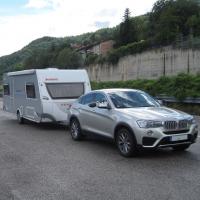
I’m missing my basic physics here. The weight of the car, caravan and Scott is a fixed value. The only weight difference I can see is the transfer from car to caravan. Once seated in its housing the cart spring may try and lift the vehicle tow bar? To every action there must be an opposite and equal reaction. Totally confused now🤪🤪🤪As I used to have to put quite a lifting load into seating the Scott's spring bar it is challenging to think that "load" then taken by the "A" frame actually reduces the force down onto the tow ball.
There is more than a little confused thinking here between towball, "noseweight" and axle loading coming in, surely?

-
We’re currently investigating an issue related to the forum theme and styling that is impacting page layout and visual formatting. The problem has been identified, and we are actively working on a resolution. There is no impact to user data or functionality, this is strictly a front-end display issue. We’ll post an update once the fix has been deployed. Thanks for your patience while we get this sorted.
You are using an out of date browser. It may not display this or other websites correctly.
You should upgrade or use an alternative browser.
You should upgrade or use an alternative browser.
ATC ???
Page 3 - Passionate about caravans & motorhome? Join our community to share that passion with a global audience!

As I used to have to put quite a lifting load into seating the Scott's spring bar it is challenging to think that "load" then taken by the "A" frame actually reduces the force down onto the tow ball.
There is more than a little confused thinking here between towball, "noseweight" and axle loading coming in, surely?
Ok This is quite likely to be twaddle but I'll have a go. We need a physicist to help.
The caravan chassis rests on the tow ball at the hitch. Whatever the downward force happens to be it is the weight transferred from caravan to tow ball at the hitch. If you add weight to the front of the caravan than that will increase and so on.
Now in the case of the Scott then the thing is clamped to the tow ball and the long spring rests on a receiver attached to the side of the chassis "A" frame.
My memory is certainly not of requiring 40 kg or 50 kg of upward lifting force to bring the end of the spring to a height where it can engage with the receiver. It used to rest a few inches below the receiver and it was simply a case of flexing the spring vertically. My recollection is more the amount of sideways force to get it to snap into place in the receiver. I used to kick it in.
Now. The caravan is already resting on the towball at the hitch if we ignore the Scott.
But, the Scott addition is a spring that is clamped to the tow ball (close anyway) and also "fixed" but able to slide, to the caravan chassis "A" frame.
If the tensioned spring is bearing down on the "A" frame slider (in other words apparently forcing that receiver down) then I think I can remember something about equal and opposite reactions in my physics.
My presumption is that this equal and opposite reaction will, in effect, try to raise the tow ball and thus appear to reduce the nose-weight.
Go easy on me please.
Thankfully on this forum people are prepared to stick their neck out and long may that be the case. 🙄
Ah Read your response after posting mine. Lol That's two of us confused.I’m missing my basic physics here. The weight of the car, caravan and Scott is a fixed value. The only weight difference I can see is the transfer from car to caravan. Once seated in its housing the cart spring may try and lift the vehicle tow bar? To every action there must be an opposite and equal reaction. Totally confused now🤪🤪🤪
But I think the "equal and opposite reaction" is the key.
This is American but may help to explain how weight distribution hitches work, the Scott/Bulldog though transfered less weight than the US types.
 .
.
How The Weight Distribution Hitch Work?
Understanding the principles behind the weight distribution hitch will give you a better idea of how it works and how important it is. Keep reading to know.
tophitches.com
As you have to lift the Scott spring into place, once it is there it is pushing down on the "A" frame.
As it pushes down on the "A" frame close to the towball, most of that force it is pushing down is carried by the ball, but some by the caravan's axle; its simple levers. Reflecting the distances away from the ball to where the Scott bears down and ball to caravan axle.
But once coupled up, there can't be but an increase in the force down onto the ball, ie the normal force from the van's weight plus the force from the Scott's spring.
As has been said there must be a balancing force.
Well the towbar as opposed to the towball is holding the other end of the Scott, so that's playing a role.
If you think of the system as a see-saw that pulling up of the Scott to get it into the "A" frame holder tips the front of the car down.
Therefore, we see the car's front axle gets loaded a bit more and the caravan's axle gets loaded a bit more; with me so far?
At the end of the day the weight has not changed, it is still the sum of the van, the Scott, and the tow car. But we know from above by fitting the Scott both the car's front axle and the caravan's axle or axles, each are taking a bit more than without it. Therefore, it follows the car's rear axle must be relieved by exactly the sum of those two increases.
As the Americans and Aussies do with their very much stronger springs than the Scotts, they recover a bit more front axle steering and relieve the burden on the vehicles rear axle a bit. The stronger the spings involve the greater these changes.
As it pushes down on the "A" frame close to the towball, most of that force it is pushing down is carried by the ball, but some by the caravan's axle; its simple levers. Reflecting the distances away from the ball to where the Scott bears down and ball to caravan axle.
But once coupled up, there can't be but an increase in the force down onto the ball, ie the normal force from the van's weight plus the force from the Scott's spring.
As has been said there must be a balancing force.
Well the towbar as opposed to the towball is holding the other end of the Scott, so that's playing a role.
If you think of the system as a see-saw that pulling up of the Scott to get it into the "A" frame holder tips the front of the car down.
Therefore, we see the car's front axle gets loaded a bit more and the caravan's axle gets loaded a bit more; with me so far?
At the end of the day the weight has not changed, it is still the sum of the van, the Scott, and the tow car. But we know from above by fitting the Scott both the car's front axle and the caravan's axle or axles, each are taking a bit more than without it. Therefore, it follows the car's rear axle must be relieved by exactly the sum of those two increases.
As the Americans and Aussies do with their very much stronger springs than the Scotts, they recover a bit more front axle steering and relieve the burden on the vehicles rear axle a bit. The stronger the spings involve the greater these changes.
Last edited:
It doesn't reduce the load on the towbar but it does reduce the load on the rear axle.Thanks Roger ,
So the yanks say it reduces nose load. Prof says the opposite. 🤪🤪🤪

Roger has correctly understood the dynamics involved.
In my description I only concentrated of the nose load aspect which was the question that was raised. The figure I used were more from memory, and I remember how much effort I had to use to shift the reaction arm into is A frame holder, and of course that will be affected by the particular design.
I stand by my description, of the effect on the actual nose load applied to the tow vehicle, and whilst I did not pursue the line of thought I did mention that as the reaction arm was lifted, you might detect the rear of the car also being lifted, which does in fact transfer some load on the tow vehicles rear axle to the front axle. This is the same principle as the USA system, but on a significantly different scale.
The difference in the strength of the effect between the American and the UK systems, and where as the UK systems may transfer a few tens of Kg. The USA versions may transfer a few 100kg of load.
The UK versions were principally designed to in crease the resistance of the articulation between the tow vehicle and trailer. They did this by including friction pads. They were not intended to act as axle load redistribution systems. The USA versions were design as load redistributes, and the two I have seen did not include friction pads to stop sway.
Neither of these systems would be as effective at damping trailer instability as the ATC type of system.
In my description I only concentrated of the nose load aspect which was the question that was raised. The figure I used were more from memory, and I remember how much effort I had to use to shift the reaction arm into is A frame holder, and of course that will be affected by the particular design.
I stand by my description, of the effect on the actual nose load applied to the tow vehicle, and whilst I did not pursue the line of thought I did mention that as the reaction arm was lifted, you might detect the rear of the car also being lifted, which does in fact transfer some load on the tow vehicles rear axle to the front axle. This is the same principle as the USA system, but on a significantly different scale.
The difference in the strength of the effect between the American and the UK systems, and where as the UK systems may transfer a few tens of Kg. The USA versions may transfer a few 100kg of load.
The UK versions were principally designed to in crease the resistance of the articulation between the tow vehicle and trailer. They did this by including friction pads. They were not intended to act as axle load redistribution systems. The USA versions were design as load redistributes, and the two I have seen did not include friction pads to stop sway.
Neither of these systems would be as effective at damping trailer instability as the ATC type of system.
I disagree with your last comment - the Scott-Halley / Bulldog blade stabilisers apply friction to dampen trailer sway with similar damping force to Alko ATC - but the Alko ATC is much more convenient to use.Neither of these systems would be as effective at damping trailer instability as the ATC type of system.
I never suggested the makes you mention don't help to reduce lateral movements they do, as witnessed the previous paragraph, but the ATC system has much greater capacity through its electrical activation on the road brakes, and the leverage to produce a more effective damping system than almost any friction pad based system at or near the hitch.I disagree with your last comment - the Scott-Halley / Bulldog blade stabilisers apply friction to dampen trailer sway with similar damping force to Alko ATC - but the Alko ATC is much more convenient to use.

How can you directly compare the damping of a Bulldog/Scoot friction stabiliser working on the towball/towbar to ATC that applies the brakes?I disagree with your last comment - the Scott-Halley / Bulldog blade stabilisers apply friction to dampen trailer sway with similar damping force to Alko ATC - but the Alko ATC is much more convenient to use.
Although I’ve had Alko hitch stabilisers for 15 years now I always felt that the area of friction material on the Bulldog was quite a lot more than the Alko. But obviously I wasn’t in a position to judge the damping force provided by the respective types as friction material and clamping forces will affect the performance. Otherwise I’ve never had any real concerns when towing. Probably because the cars have been heavy cf caravan and well below 85% and loaded sensibly.
I disagree with your last comment - the Scott-Halley / Bulldog blade stabilisers apply friction to dampen trailer sway with similar damping force to Alko ATC - but the Alko ATC is much more convenient to use.
Are you getting the Al-KO ATC confused with their AKS stabilisers ?
The AKS like the Scott is a "damper" that uses friction pivoting around the coupling, whereas the ATC is a dynamic stability system using the van's brakes to "weathercock" the van behind the tow car, it actually is the car pulling a dragging van that provides the stabilisation.
======================================
Where friction forces are being discussed, it should be noted area of the pads play no part in the forces involved, that is down to the loading and the coefficient of friction of the materials against each other. Other factors will be radius where it acts, but not area.
Having area helps in living with the loads involved, but not in the friction forces developed.
You're right - well spotted!Are you getting the Al-KO ATC confused with their AKS stabilisers ?
The AKS like the Scott is a "damper" that uses friction pivoting around the coupling, whereas the ATC is a dynamic stability system using the van's brakes to "weathercock" the van behind the tow car, it actually is the car pulling a dragging van that provides the stabilisation.
======================================
Where friction forces are being discussed, it should be noted area of the pads play no part in the forces involved, that is down to the loading and the coefficient of friction of the materials against each other. Other factors will be radius where it acts, but not area.
Having area helps in living with the loads involved, but not in the friction forces developed.
Are you getting the Al-KO ATC confused with their AKS stabilisers ?
The AKS like the Scott is a "damper" that uses friction pivoting around the coupling, whereas the ATC is a dynamic stability system using the van's brakes to "weathercock" the van behind the tow car, it actually is the car pulling a dragging van that provides the stabilisation.
======================================
Where friction forces are being discussed, it should be noted area of the pads play no part in the forces involved, that is down to the loading and the coefficient of friction of the materials against each other. Other factors will be radius where it acts, but not area.
Having area helps in living with the loads involved, but not in the friction forces developed.
I’d agree with your comment regarding area if the force being applied to discs remains constant. Ie 1600 lbf applied to 8 sqinch pads is 200psi, whereas 1600 lbf applied to 4 sqin pads is 400 psi. So the braking force vis constant. But without knowing the respective forces applied to Bulldog friction pads and Alko stabiliser pads it’s not possible to dismiss differences in friction pad areas. Soley because like for like is not being compared. Both in areas and geometric design.
Last edited:
It would be very difficult to make meaningful comparisons about the friction pad effectiveness when comparing Ball friction and outboard stabilisers, mainly becasue there are so many variables about how the are set up and of course how much wear they have been subjected to.
But I do make a distinction between hitch stabiliser and reaction arm stabilisers when it comes to vertical motions. The friction hitch designs simply make the vertical articulation more resistive and they don't automatically try to reset normal towing. By comparison reaction arms are continually applying a downward force on the A frame, and when a vertical deflection is encountered the tension in the arm will resist it. and it will try to settle back to its normal position.
Which is better is down to personal preferences, but my own experience suggests the reaction arm units have a smoother vertical motion, but the difference is relatively small.
I have never driven an outfit with ATC, so I cannot offer an opinion based on experience, but the design concept of using the trailers own brakes to provide the corrective action make a lot of good mechanical sense, and it should be able to provide a more powerful corrective action than any hitch based system. I am not suggesting hitch based systems are no good, far from it. Hitch based systems have a proven track record of helping to tame trailer instability, its just that ATC (et al) has so many mechanical advantages it is bound to be better.
Should ATC be a standard fit to all caravans? There is a good safety case for it, but there are strong economic reasons against it.
But I do make a distinction between hitch stabiliser and reaction arm stabilisers when it comes to vertical motions. The friction hitch designs simply make the vertical articulation more resistive and they don't automatically try to reset normal towing. By comparison reaction arms are continually applying a downward force on the A frame, and when a vertical deflection is encountered the tension in the arm will resist it. and it will try to settle back to its normal position.
Which is better is down to personal preferences, but my own experience suggests the reaction arm units have a smoother vertical motion, but the difference is relatively small.
I have never driven an outfit with ATC, so I cannot offer an opinion based on experience, but the design concept of using the trailers own brakes to provide the corrective action make a lot of good mechanical sense, and it should be able to provide a more powerful corrective action than any hitch based system. I am not suggesting hitch based systems are no good, far from it. Hitch based systems have a proven track record of helping to tame trailer instability, its just that ATC (et al) has so many mechanical advantages it is bound to be better.
Should ATC be a standard fit to all caravans? There is a good safety case for it, but there are strong economic reasons against it.

IMO the friction based stabilisers we have add damping that mitigates the low order swaying movements inevitable towing our caravans so improves the towing experience and therefore lowers driver and passenger fatigue.
They are however of so low a damping level that if the towed unit encounters a significant distrurbance with potential to develop into a full on snake, they simply are overwhelmed.
It is here the likes of ATC come usefully into play.
With ATC, the interaction of significantly increasing the van's "drag" by partially applying its brakes and the force this develops from the towing vehicle's forward movement, pull the van back into line. It also reduces the road speed which in itself is a primary factor in the sensitivity of the unit to snake. Things here being massively more powerful in abating a snake than a bit of low order friction damping can ever offer.
These two systems are therefore quite different in what the aim to achieve but fortunately complimentary to each other, you can have the smoother towing experience offered by the "stabiliser" whilst having a device to largely avoid a snake developing into something with high energy.
There is no "one is better than the other" or one replacing the other they are addressing fundamentally different tasks for us, one basically just a comfort aid the other directly focused on towing safety.
I am in the camp of ATC and its ilks ought to be mandatory; technology has developed a cost effective way of making towing safer than without. In its case both for those within the vehicle and third parties.
I don't see why legislators should regard it any different to the treatment of seatbelts, crumple zones and ABS in vehicles, all added cost safety related features but something we must have in new kit if we want to join others and use the roads.
They are however of so low a damping level that if the towed unit encounters a significant distrurbance with potential to develop into a full on snake, they simply are overwhelmed.
It is here the likes of ATC come usefully into play.
With ATC, the interaction of significantly increasing the van's "drag" by partially applying its brakes and the force this develops from the towing vehicle's forward movement, pull the van back into line. It also reduces the road speed which in itself is a primary factor in the sensitivity of the unit to snake. Things here being massively more powerful in abating a snake than a bit of low order friction damping can ever offer.
These two systems are therefore quite different in what the aim to achieve but fortunately complimentary to each other, you can have the smoother towing experience offered by the "stabiliser" whilst having a device to largely avoid a snake developing into something with high energy.
There is no "one is better than the other" or one replacing the other they are addressing fundamentally different tasks for us, one basically just a comfort aid the other directly focused on towing safety.
I am in the camp of ATC and its ilks ought to be mandatory; technology has developed a cost effective way of making towing safer than without. In its case both for those within the vehicle and third parties.
I don't see why legislators should regard it any different to the treatment of seatbelts, crumple zones and ABS in vehicles, all added cost safety related features but something we must have in new kit if we want to join others and use the roads.
Last edited:

TRENDING THREADS
-
-

-

-
-
-
-
Venus Lunar 550/4 Truma Water Pump , kitchen and bathroom sink ....
- Started by Thomas Dixon
- Replies: 1