• We’re currently investigating an issue related to the forum theme and styling that is impacting page layout and visual formatting. The problem has been identified, and we are actively working on a resolution. There is no impact to user data or functionality, this is strictly a front-end display issue. We’ll post an update once the fix has been deployed. Thanks for your patience while we get this sorted.

Slingshotting? Yes or no?

Perhaps someone can explain to me as a visitor to the UK what the purpose of a right hand lane is as one enters a roundabout? Sooner or later one has got to move over to the left in order to exit the roundabout anyway so why not place yourself in the left hand lane before you enter? If it's meant for those wishing to exit on a road leading off the roundabout to the right then it means changing lanes twice, once into the right hand lane before you get to the roundabout and again when you're about to exit the roundabout. I find that quite unnecessary. It's always puzzled me.

 
Perhaps someone can explain to me as a visitor to the UK what the purpose of a right hand lane is as one enters a roundabout? Sooner or later one has got to move over to the left in order to exit the roundabout anyway so why not place yourself in the left hand lane before you enter? If it's meant for those wishing to exit on a road leading off the roundabout to the right then it means changing lanes twice, once into the right hand lane before you get to the roundabout and again when you're about to exit the roundabout. I find that quite unnecessary. It's always puzzled me.

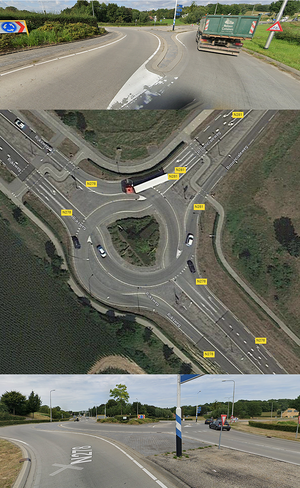
The lanes on some roundabouts spiral outwards so by entering in the inner lane, it'll be the outside lane by the time you've gone round 270 degrees.
 
The lanes on some roundabouts spiral outwards so by entering in the inner lane, it'll be the outside lane by the time you've gone round 270 degrees.

But the spiral can only apply to one entry point. If you enter the roundabout somewhere later and exit later, too, you would have to cross a spiral lane marking.
 
Perhaps someone can explain to me as a visitor to the UK what the purpose of a right hand lane is as one enters a roundabout? Sooner or later one has got to move over to the left in order to exit the roundabout anyway so why not place yourself in the left hand lane before you enter? If it's meant for those wishing to exit on a road leading off the roundabout to the right then it means changing lanes twice, once into the right hand lane before you get to the roundabout and again when you're about to exit the roundabout. I find that quite unnecessary. It's always puzzled me.
It actually works fine a recent post showed the schematic from the Highway Code. Although sometimes with the caravan I would enter on the left lane and continue going around the island until I exited. But I was always careful to indicate my intention and aware of any cars in the inner lane that wanted to leave at the same exit as me.
 
The lanes on some roundabouts spiral outwards so by entering in the inner lane, it'll be the outside lane by the time you've gone round 270 degrees.
Wouldn't it be 450 degree as you are going right around the round about passing your original entry point? Apologies if my maths is out?
 
I confess that there are times when I've done this. The other thing I've seen is vehicles leaving on a slip road from a dual carrageway that's slowed to a halt then going round the roundabout at the top and back onto the dual carrageway. Saves all of a few seconds 🙄

I was in MK just the other week and had forgotten about all the roundabouts. Was grateful for them as we often got lost and went around them twice - first to survey, then to get off.
 
No joke that round about and I made sure that I did not come back that way preferring the longer route to bypass it.
I always liked "magic roundabouts", particularly the one at Hemel Hempstead - to make a notional right turn it was much quicker to go the "wrong" way round.

Some drivers can't cope when two mini roundabouts are used together.
 
The other thing I've seen is vehicles leaving on a slip road from a dual carrageway that's slowed to a halt then going round the roundabout at the top and back onto the dual carrageway. Saves all of a few seconds 🙄
.......this can save you more than a few seconds!
Junctions 10 and 11 on the M25 have standing traffic every day at rush hours.
I have used the technique to jump traffic taking note of a sign written van I am leaving behind.
Since I only drive at around 60 mph as I find it less stressful, sometimes the same van takes 15- 20 minutes to pass me once the traffic has got moving.
I know it's jumping the queue and questionable driver etiquette but it's dog eat dog on the M25 anyway.
 
.......this can save you more than a few seconds!
Junctions 10 and 11 on the M25 have standing traffic every day at rush hours.
I have used the technique to jump traffic taking note of a sign written van I am leaving behind.
Since I only drive at around 60 mph as I find it less stressful, sometimes the same van takes 15- 20 minutes to pass me once the traffic has got moving.
I know it's jumping the queue and questionable driver etiquette but it's dog eat dog on the M25 anyway.
The SatNav in my Santa Fe will doe this if the traffic on the motorway is down to about 40 mph.
 
Dutchroundabout.pngAlways liked how some roundabouts are designed in Holland.
A physical barrier between lanes and as often as not a separate cycle path.
 
Not very smooth if you want to go right round and back the way you came when you missed the previous turn.
 

TRENDING THREADS

Latest posts

Back
Top