• We’re currently investigating an issue related to the forum theme and styling that is impacting page layout and visual formatting. The problem has been identified, and we are actively working on a resolution. There is no impact to user data or functionality, this is strictly a front-end display issue. We’ll post an update once the fix has been deployed. Thanks for your patience while we get this sorted.

Calculating draw in amps for Thetford N112 Fridge

Hi there,
I'm a novice so excuse me if this is a very simple question. Im currently trying to work out my energy requirements for my van so I can get the right battery bank and solar panels. I am trying to work out the draw of my thetford N112 Fridge freezer in Amps when on 12v DC. Does anyone know how Im best to work this out or have a similar model and know the draw in amps?
Cheers in advance
 
Hello Phil,.

I cant give you specific figures for your model, but it is generally the case that its impractical to run them on solar panels and or batteries. They require too much constant power which either needs to be provided directly by the panels and of course at night by the batteries. The size and weight of batteries to meet this demand will use up or even exceed you caravans weight allowance.

It is far more practical to run them obviously on mains if you have a mains hook up site, otherwise the only practical solution is the LPG. 12V is only realistic when you are actually towing.

Generally a minimum of a 50W panel and a 110Ah is usually enough to keep the normal 12V systems topped up when of grid. Look to low wattage lightying, and be frugal with the use of TV or computers etc.

Generators are not as efficient as using gas , plus the are noisy and some sites have strict rules about them.
 
If you look on the Thetford website it shows the details of kwhr per 24 hours on 230v, and grams of gas per 24 hours on gas. Nothing about 12v. But are you sure that it runs on 12v DC other than when connected to the car's circuits via the cable connector? In which case its power draw is suppled by the cars alternator.
https://www.thetfordfridges.co.uk/n112.htm
 
So I was hoping to do a combination of 12v and gas when off grid. I was a bit worried we'd run out of gas very quickly if we were using on gas all the time while stationary? The van only holds a 6kg gas bottle you! Are they efficient on gas? When on EHU will definitely use that however we plan on doing as much off grid as possible.
 
All makes of caravan fridge are primarily designed to use gas as the most efficient fuel source.

The electric side of things only came as a result of consumer pressure and the increase in EHU on site.

No caravan fridge will work off the 12v leisure battery, it will only work when the van is connected to the car and the car engine is running, ie whilst towing, when it will draw around 10 Amps.
 
Consider using a generator if allowed.

phillipsmr said:
So I was hoping to do a combination of 12v and gas when off grid. I was a bit worried we'd run out of gas very quickly if we were using on gas all the time while stationary? The van only holds a 6kg gas bottle you! Are they efficient on gas? When on EHU will definitely use that however we plan on doing as much off grid as possible.
 
phillipsmr said:
So I was hoping to do a combination of 12v and gas when off grid. I was a bit worried we'd run out of gas very quickly if we were using on gas all the time while stationary? The van only holds a 6kg gas bottle you! Are they efficient on gas? When on EHU will definitely use that however we plan on doing as much off grid as possible.

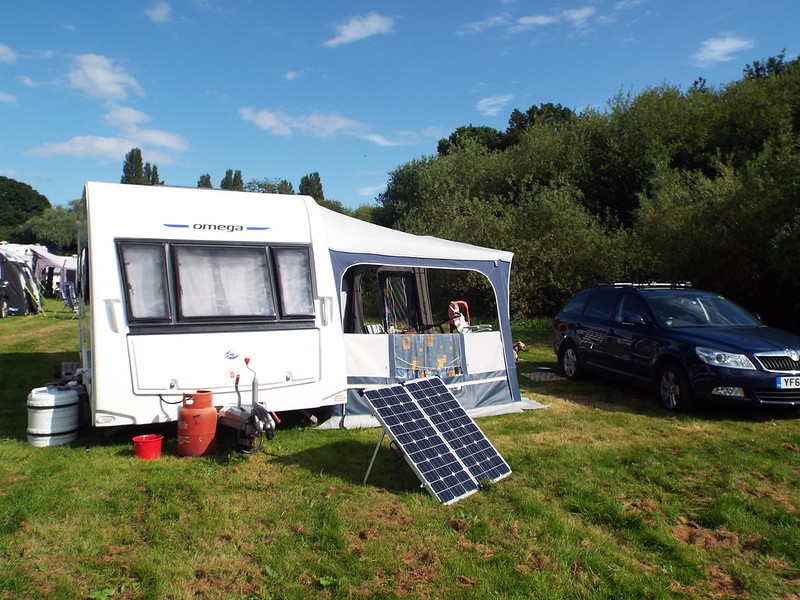
I use a 150w folding panel and a 11kg Flogas cylinder; gas for fridge, cooking, BBQ and hot water, still had gas left after 15 nights in July.

36271490931_62e3ba4c50_c.jpg
 
xtrailman said:
Consider using a generator if allowed...

Running a generator to power a fridge is frighteningly expensive and inefficient way to do it.

The LPG side of fridge has to be at least 70% efficient by law. At best a small generator will only be about 10 to 12% efficient, but in practice you will not be using all the power you produce which further reduces the efficiency. The cost of purchasing and maintaining the generator would buy a lot of LPG.
 
Why would you only power the fridge with a generator?

ProfJohnL said:
xtrailman said:
Consider using a generator if allowed...

Running a generator to power a fridge is frighteningly expensive and inefficient way to do it.

The LPG side of fridge has to be at least 70% efficient by law. At best a small generator will only be about 10 to 12% efficient, but in practice you will not be using all the power you produce which further reduces the efficiency. The cost of purchasing and maintaining the generator would buy a lot of LPG.
 
xtrailman said:
Why would you only power the fridge with a generator?

ProfJohnL said:
xtrailman said:
Consider using a generator if allowed...

Running a generator to power a fridge is frighteningly expensive and inefficient way to do it.

The LPG side of fridge has to be at least 70% efficient by law. At best a small generator will only be about 10 to 12% efficient, but in practice you will not be using all the power you produce which further reduces the efficiency. The cost of purchasing and maintaining the generator would buy a lot of LPG.

The OP's question related to running a fridge, and if that is the primary reason for investigating the use of a generator then knowing there is a far more efficient, and certainly quieter and probably cheaper way of powering the fridge, it should make you question if a generator is the best way to go.

In some circumstances a generator may be the most appropriate solution for remote power, and I have been in situations where I needed 230V for other equipment, but it is difficult to justify a generator for a fridge if LPG is available.
 
I’ve taken this from one of my previous posts. As the Prof points out modern caravan fridges are very gas efficient.

A super fridge freezer fitted in some TAs eg Dometic RMD 8555 will use 380 grams over 24 hours in an ambient temperature of 25 deg C.
A smaller more common unit will use 187 to 257 grams per 24 hours at 25 deg C . The higher use rate assumes you set the fridge to maximum cooling.
So let's assume 200 g per 24 hrs you new 4.5 kilo cylinder should last 22.5 days.
Don't forget to reduce the time if you use the cooker , water and room heaters.
Plus I assume you carry two cylinders so you shouldn't run out!

:cheer:
Read more at https://www.practicalcaravan.com/forum/general/51224-how-much-gas-does-a-fridge-use#W74TK1uqSsS5TY1X.99
 
Hello Phillipsmr,
Looking at the responses no one actually tells you how to calculate amps - the answer is divide watts (W) by voltage (V).
The fridge rating plate should give you the info you need,it might even specify the amps, saving you the need to calculate.
The above is true for any direct current (dc) device.
 
bertieboy1 said:
Hello Phillipsmr,
Looking at the responses no one actually tells you how to calculate amps - the answer is divide watts (W) by voltage (V).
The fridge rating plate should give you the info you need,it might even specify the amps, saving you the need to calculate.
The above is true for any direct current (dc) device.

Nobody has answered because its not usual to run a fridge off a caravan battery.

The current is also variable depending on the voltage to the fridge, so not fixed.
 
We have been on sites with only 6 amp supplies and run the fridge in very hot weather on gas. In practice they are very economical, and provided you have a decent amount in the gas cylinder you should have little problem. The main problem could be if the gas runs out just after you have gone out for the day in hot weather, but you can get a change over system if you think this could be a problem assuming you carry a spare cylinder.
 
Hello Xtrailman,
It doesn't really matter that you can't in practise run fridge off caravan battery.The question is still there and no one answered it.
 
If you need an answer then look at the data label inside the fridge.
If its 170watts at 12 v DC then it is indeed 170 divided by 12.

However to calculate current for other voltages then you need to calculate the resistance of the element, and use a different formula to work out the current. Most people wouldn't be Interested.
 
Hi Xtrail man, as Berti boy states, nobody has come back with an answer, I checked on other websites and the only info I can get is that the fridge on 12 volts when hooked up to a car "might " draw as much as 10 amps. This seems very high, but wiring diagrams show that the fridge thermostat is not used in 12 volts usage. So the fridge would be all out to keep cool.
 
Not always some fridges are controlled by the thermostat for all three fuels, my last Unicorn fridge was.

EH52ARH said:
Hi Xtrail man, as Berti boy states, nobody has come back with an answer, I checked on other websites and the only info I can get is that the fridge on 12 volts when hooked up to a car "might " draw as much as 10 amps. This seems very high, but wiring diagrams show that the fridge thermostat is not used in 12 volts usage. So the fridge would be all out to keep cool.
 
xtrailman said:
Not always some fridges are controlled by the thermostat for all three fuels, my last Unicorn fridge was.

EH52ARH said:
Hi Xtrail man, as Berti boy states, nobody has come back with an answer, I checked on other websites and the only info I can get is that the fridge on 12 volts when hooked up to a car "might " draw as much as 10 amps. This seems very high, but wiring diagrams show that the fridge thermostat is not used in 12 volts usage. So the fridge would be all out to keep cool.

I sit corrected. :S
 
My present Swift has a 170 watt element rated at 12 volts DC.

current is equal to 170 / 12 = 14.167 amps. (W / V)

Therefore resistance of the element = voltage/ current = 12 / 14.167 = 0.847 ohms. (or you could use V squared / power (watt))

If the fridge supply is increased to 14 V for example the current would now equal V / R = 14 / 0.847 = 16.53 Amp

You need to establish the power rating of your particular fridge, my last one was only 130watt. So each one can vary depending on model.
 
The current flowing in a circuit is determined by the supply voltage and the total resistance of the circuit.

Current (l) = Volts(V) ÷ Resistance (R).

By the same token power in Watts(W) = Volts(V)×Amps(I)

It is a convention to quote the power Dissipation of an electric element based on its notional standard Voltage.And designers and manufacturers are expected to ensure the electrical device will survive exposure to the normal range that any nominal supply can go through.

12V circuits are expected to operate between 10.5 to 14.5 V. Consequently the fridges 12V element should cope with that range of voltages without concern. When at working temperatures, 12V elements will have a resistance. So if the voltage rises, so will the current. In practical terms the change in current will be proportional to the change in voltage,and to all intents and purposes that will be good enough to estimate current draw, but scientifically, the resistance of an element will change in response to the temperature of the element, and an increase in voltage will cause more current to flow, but at the same time. more current means the element will disipate more power, which will raise its temperature which willcrease the elements resistance.

It is often assumed that heating elements have a constant Resistance, but in fact in common with most materials, the electrical resistance of a element does change with temperature. So the resistance of a cold element will be different to a hot one. How much it will change is dependant on the material used. In general conducting metals will have positive temperature coefficient and become more resistive with increasing temperature. There are some exotic materials that have a negative temperature cofficients

 

TRENDING THREADS

Latest posts

Back
Top