
• We’re currently investigating an issue related to the forum theme and styling that is impacting page layout and visual formatting. The problem has been identified, and we are actively working on a resolution. There is no impact to user data or functionality, this is strictly a front-end display issue. We’ll post an update once the fix has been deployed. Thanks for your patience while we get this sorted.

Twin Axle - why both in the middle?

Can anybody suggest a reason why a twin axle caravan should have the axles together in the middle, rather than one at each end.

You quite often see lorries with trailers of this configuration.

As far as I can see;

Downside -

You need to have a pivot, so that the front wheels can steer on corners; either a central pivot or one per wheel, linked, as a car. Obviuosly this involves extra weight and cost.

It would be more difficult to level - as per a motorhome.

Upside.

Noseweight ceases to exist - it is just the weight of the drawbar.

Fore and aft loading becomes far less significant.

Longtitudinal stability should be greatly improved.

No legs would be needed.

Any thoughts out there?
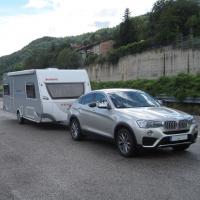
 
I remember reading an artical about an old caravan that had 2 axles which were further apart than a modern twin axle. It mentioned in the artical that because of this set up the caravan could be towed at a faster speed as it fell outside the rules governing "normal" caravans. So maybe the reason for the distance between axles is determined by law and if increased would make the caravan fall into another class of road vehicle and come under a different set of rules and regs.

Another one for Lutz to research ;o)

Brian (",)
 
Lynton Caravans produced such a 'van some years ago but it never caught on. I assume because of the chassis configuration it was expense as the front axle was articulated. You do see some of the fairground and circus people using such a configuration but they are big 'vans towed by lorries.
 
Many people must have seen continental trailers in markets that are built that way.

I've only ever seen them towed at moderate speed, but they do seem to carry a lot of weight.
 
Lynton Caravans produced such a 'van some years ago but it never caught on. I assume because of the chassis configuration it was expense as the front axle was articulated. You do see some of the fairground and circus people using such a configuration but they are big 'vans towed by lorries.
edited to say....it was expensive as the front axle was articulated.
 
The front wheels would as you say, would need to steer. Some agricultural trailers use this method as well.

When I first started to use tractors at the age of 14, this was the type of trailer that I was given to practice reversing with.

All I can say is that it is really not easy, normal trailer wheel configuration reversing is easy, the front steering wheel configuration really is not, it would always be amusing on site though
 
Dusty is correct, except that I thought it was a Sprite. I saw it on the M4 in Newport many years ago - 1970s perhaps? It looked most ungainly. Around that time there was a loophole in the law which allowed trailers with widespread axles ( over 1 metre, I think) to travel at 70mph when the normal limit was 50.
 
The law does not allow a trailer with a steerable front axle to be towed behind any other than a commercial vehicle over 3500kg and it requires its own service brake (i.e. not an overrun brake).
 
OK, I've been caravanning for a hundred years (well, over 50) and I remember at one stage a caravan with two axles, which were not "close coupled" (up to a metre apart?), there was a speed limit of 40 mph.
 
OK, I've been caravanning for a hundred years (well, over 50) and I remember at one stage a caravan with two axles, which were not "close coupled" (up to a metre apart?), there was a speed limit of 40 mph.
 
As Dusty said it was made by Lynton

The front swivelling axle was accommodated by having a raised front floor section so there was a step up into the front dinette
 
Hi all,

some HGV drawbar trailers use this layout but they have a turntable above the front axle and pivot again on the tow hitch, the two pivot points make reversing very difficult. A caravan can be reversed very easily and the longer it is the easier it gets as you only have one pivot point to watch but a car and a turntable drawbar would cut corners and be very difficult to park with a much larger turning circle, it would also be heavier, expensive and difficult to level. As previously mentioned the brakes would not work with an over run device, HGVs have an air compressor with air pressure fed through a foot brake valve to brake chambers, cars have none of this.
 
Having had to reverse an a-frame drawbar a few times I can concur that it is an utter nightmare and this the majority of HGV drivers would say.

In fact in the days of the nationalised BRS (British Road Services they classed these drivers differently and had a "extra" in the wage packet but only after they had attended a 5 day training course!!

Yes it it does offer stability but it's not popular even now in trucking circles

Regards
 
Having had to reverse an a-frame drawbar a few times I can concur that it is an utter nightmare and this the majority of HGV drivers would say.

In fact in the days of the nationalised BRS (British Road Services they classed these drivers differently and had a "extra" in the wage packet but only after they had attended a 5 day training course!!

Yes it it does offer stability but it's not popular even now in trucking circles

Regards
Hi,

My Name is Roy Heathcote, I designed and built the four corner wheeled caravan (Lynton Excalibur). Should you require any info please reply.

Roy
 

TRENDING THREADS

Back
Top