• We’re currently investigating an issue related to the forum theme and styling that is impacting page layout and visual formatting. The problem has been identified, and we are actively working on a resolution. There is no impact to user data or functionality, this is strictly a front-end display issue. We’ll post an update once the fix has been deployed. Thanks for your patience while we get this sorted.

where to put the jack.

Good day everyone! Actually the question is how to change the wheel. How to determine the right place to install the jack.
To raise the wheel, do I need to put a jack under the axle, or under the lever, or is there space on the frame?
Would be nice if someone could post pictures.
 
Last edited by a moderator:
Good day everyone! Actually the question is how to change the wheel. How to determine the right place to install the jack.
To raise the wheel, do I need to put a jack under the axle, or under the lever, or is there space on the frame?
Would be nice if someone could post pictures.

Put the jack under the axle close to the wheel but not on the suspension. If not hitching it to the car lock the nose wheel either by putting a large breeze block either side or by setting it into the groove on its tube. Put wedges under the non lifting wheel too. I also used to go around and adjust the opposite steadies as the van was progressively lifted. The aim being to do everything you can to stop it moving as you lift it. Slacken the wheel nuts prior to lifting.
 
Last edited by a moderator:
Like Clive it is best if needed to leave attached to the car to prevent any movement on the caravan while you are working. Even so set the handbrake as a precaution. Slacken the nuts, then raise the van, attach the new wheel, lower the van and re-torque the nuts to specified settings - then after a few miles recheck the torque settings.
 
When mobile fitters have worked on my caravans, they put a trolley jack under the chassis frame immediately behind the wheel - the comments above about leaving it attached to the car are excellent advice.
 
Your caravan probably has an Alko chassis, and these must be lifted correctly to avoid doing irreparable damage to the chassis C sections. Alko sell jacking points which are bolt on brackets. They also sell side lift jacks. These are designed by the chassis manufacturer, its a good place to start. Go to the Alko website and you will see all the details, or read your caravan manual.
 
Your caravan probably has an Alko chassis, and these must be lifted correctly to avoid doing irreparable damage to the chassis C sections. Alko sell jacking points which are bolt on brackets. They also sell side lift jacks. These are designed by the chassis manufacturer, its a good place to start. Go to the Alko website and you will see all the details, or read your caravan manual.
Isn't it an Elddis which I think used the BPW chassis?
 
Until relatively recently, Elddis used BPW chassis, they were bought out by Al-Ko and newer Elddis vans now have Al-Ko chassis .
 
Specialist jacking brackets are available. They must be used if you want to Jack up on the chassis rather than the axle.
The Oem Al-ok Jack is rubbish. Mine 12 years on is still in the loft. Buy a 3 phase piston hydraulic bottle jack . Safe and very good.
I no longer Jack up when attached to the car. I found the caravan body has a tendency to twist causing the bathroom door to mis fit. Weird I know but for me , properly chocked I only use the Jack unattached to the car
 
Specialist jacking brackets are available. They must be used if you want to Jack up on the chassis rather than the axle.

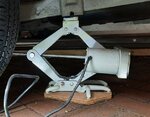
Alko supplies jacking brackets that bolt onto the 'C' section chassis rails close to the spare wheel carrier. The fitment holes are already punched into the rails. Alko also produces a screw jack that fits securely into the brackets. However, I prefer to use an electric jack under the bracket. So that it's secure, I've made up an adapter which fits inside the jacking bracket and also fits into a groove in the jacking pad, ensuring that the jack cannot slip from under the bracket.

20220111_095810.jpg
 
Alko supplies jacking brackets that bolt onto the 'C' section chassis rails close to the spare wheel carrier. The fitment holes are already punched into the rails. Alko also produces a screw jack that fits securely into the brackets. However, I prefer to use an electric jack under the bracket. So that it's secure, I've made up an adapter which fits inside the jacking bracket and also fits into a groove in the jacking pad, ensuring that the jack cannot slip from under the bracket.

View attachment 2774
This caravan is a BPW chassis not Alko.
 
Correct me but don’t Al-ko and BPW require stiffener plates on their chassis for jacking? So the principles are the same ?
I had an Elldiss of similar vintage ( late 1990s) and wasn’t aware of any stiffener plates, but when I jacked it up I used a car type scissor jack placed under the axle near to the rear of the wheel.
 

TRENDING THREADS

Latest posts

Back
Top