• We’re currently investigating an issue related to the forum theme and styling that is impacting page layout and visual formatting. The problem has been identified, and we are actively working on a resolution. There is no impact to user data or functionality, this is strictly a front-end display issue. We’ll post an update once the fix has been deployed. Thanks for your patience while we get this sorted.

Adding external 12v socket

Hi,

I have a Swift Sprite Alpine 2 with no external socket access either mains or 12v, and I'd really like to avoid cutting unnecessary holes in the outside.

I've added a secondary fuse box to run some usbc inserts for powering laptop and charging phone and I'd like to be able to run a small fridge outside, which will run off around 3a.

Given that all the electrical gubbins is on the same side as the battery and EHU insert and all inside a locket, I am wondering if it would be acceptable to add a 12v socket to the battery locker (note there is a separate compartment for the battery and EHU/motor mover isolator within the same locker).

Are there are pitfalls or issues I should think about?

Thanks in advance!
 
Last edited:
If you have a nearside locker it may have a cable cut out the same as the EHU and battery locker.
Mine has and I just ran a cable round under the seats and fitted a socket just inside the locker.
It's used for the awning pump also the awning lights. The locker shuts just fine on the cable due to the cut out. I didn't know it was there until by chance I looked.
 
If you have a nearside locker it may have a cable cut out the same as the battery locker.
Mine has and I just ran a cable round under the seats and fitted a socket just inside the locker.
It's used for the awning pump also the awning lights. The locker shuts just fine on the cable due to the cut out. I didn't know it was there until by chance I looked.
No nearside locker either sadly or that would've been exactly my plan!

The other idea is to use the vents in the floor under the nearside sofa to drop a cable through and add the socket there, doing exactly what you say with running a cable round (or even under the floor as there is a channel)
 
How about fitting a waterproof socket into the front locker ?
I think I have a 12 volt supply socket in my battery box as you mentioned, but , as I don't use it, it might have been in the last caravan.
 
How about fitting a waterproof socket into the front locker ?
I think I have a 12 volt supply socket in my battery box as you mentioned, but , as I don't use it, it might have been in the last caravan.
Interesting thought thanks, I'm a little concerned about taking electrics into the gas locker though!

Good to hear that it's been a "thing" to add to battery box - though in a way the whole point of the sealed box is rendered irrelevant as I have an LFP battery
 
Interesting thought thanks, I'm a little concerned about taking electrics into the gas locker though!

Good to hear that it's been a "thing" to add to battery box - though in a way the whole point of the sealed box is rendered irrelevant as I have an LFP battery
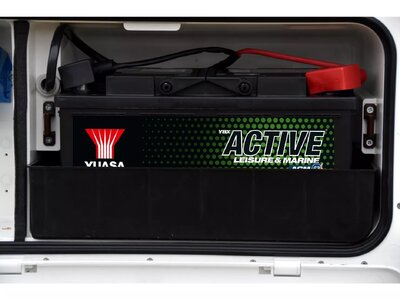
Yes, that's a thought, the compartment for the battery is sealed from the UHU , it's a shame I didn't get a full photo of the box. 466926b.jpg
 
Yes, that's a thought, the compartment for the battery is sealed from the UHU , it's a shame I didn't get a full photo of the box. View attachment 10258
Yours looks almost identical to mine - same door to open the locker but separate compartments inside.

I'd need to have a look at how much space I've got around the EHU socket and the motor mover isolator but I think that's the best way. Run the cable under the caravan to the fridge/cool box and all good!
 
Not to the purists taste possibly but we needed an external 12 volt socket to allow charging for a mobility scooter.
I simply got a cigar lighter socket, 2 lengths of suitable wire and an inline fuse. Connected straight onto the battery and tucked away in the battery box when not needed and fed out through the EHU lead cut out slot when required.
 
Not to the purists taste possibly but we needed an external 12 volt socket to allow charging for a mobility scooter.
I simply got a cigar lighter socket, 2 lengths of suitable wire and an inline fuse. Connected straight onto the battery and tucked away in the battery box when not needed and fed out through the EHU lead cut out slot when required.
Thanks, I'm reassured to read that! I think I may do very similar
 
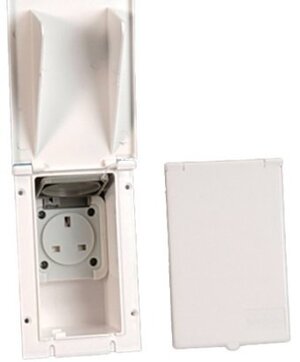
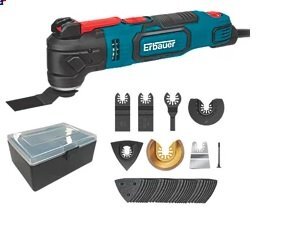
Electrical items are NOT allowed in the gas locker , neither are cables through the vent holes , these are gas safety items and if you have the caravan serviced then the engineer will condemn the caravan. Just bite the bullet and cut a hole and fit one of these , use a multitool to cut the hole. You can always remove the 13 pin socket and fit your own connector.
 

Attachments

  • Mains outlet socket-001.jpg
    Mains outlet socket-001.jpg
    11.6 KB · Views: 6
  • Erauber Multitool-001.jpg
    Erauber Multitool-001.jpg
    11.8 KB · Views: 6
Electrical items are NOT allowed in the gas locker , neither are cables through the vent holes , these are gas safety items and if you have the caravan serviced then the engineer will condemn the caravan. Just bite the bullet and cut a hole and fit one of these , use a multitool to cut the hole. You can always remove the 13 pin socket and fit your own connector.
Can you evidence the statement that cables are not able to pass through vents? We are not talking about gas drop outs, but vents in an enclosed area with no gas present or passing through.

I agree that there should be no electrics in the gas compartment. That is clear enough in what guidelines I have found.

The original question is around using the battery box and EHU area which are separate and self contained, I have the ability and tools to add an external socket but as originally stated would like to avoid cutting any holes in the outside where possible
 
Just bite the bullet and cut a hole and fit one of these , use a multitool to cut the hole. You can always remove the 13 pin socket and fit your own connector.

I am always bemused by peoples reluctance to fit any external sockets.

I have fitted a fair few external sockets of various types into the sides of various MH's and caravans and never had a problem with water ingress.
Its a very easy thing to do and I would hazard that I took vastly more care, and used more sealant, than they did at the factory.
Take your time, measure carefully, use plenty of sealant, and the jobs a good 'un.

In addition it will NOT effect any bodyshell warranty issues unless any ingress occurs actually at the site of any self installed socket (which is fair enough) this was confirmed to me, in writing, by Bailey when I asked.
 
Two things The vents are there to allow you to breathe and not allow excessive build up of CO2 and humidity as you exhale water vapour ( the skylights also help this as they do not fully seal even when shut) and to allow any build up combustible gas which may leak from the room sealed appliances. Their area has be calculated by the designer of the caravan using calculations derived from the CIBSE requirements for habitation areas and also from the appliance manufacturer installation instructions. Blocking or partially blocking will restrict the air interchange so whilst not illegal is not advisable ( A bit like people blocking air bricks in homes to reduce drafts and wondering why the windows steam up and walls go damp).
Secondly the Battery box is also required to be sealed from the habitation area to prevent harmful gases getting into the habitation area so any holes in it also need to be sealed , either with a gland or sealing mastic .( I see cables for motor movers going into the battery box without being glanded usually retro fit by the owners). If you adhere to these principle there should be no issues so crack on
I am going to fit a 20A , 12V connector to my own caravan when it comes out of storage , to connect up a 280 A.hr battery for off grid use. I will be fitting the mains outlet housing ( that i posted a picture of ) on the awning side and like Mr Plodd said , its very easy and will look neat ,IMO a far better option than faffing around with he battery box.
 
Two things The vents are there to allow you to breathe and not allow excessive build up of CO2 and humidity as you exhale water vapour ( the skylights also help this as they do not fully seal even when shut) and to allow any build up combustible gas which may leak from the room sealed appliances. Their area has be calculated by the designer of the caravan using calculations derived from the CIBSE requirements for habitation areas and also from the appliance manufacturer installation instructions. Blocking or partially blocking will restrict the air interchange so whilst not illegal is not advisable ( A bit like people blocking air bricks in homes to reduce drafts and wondering why the windows steam up and walls go damp).
Secondly the Battery box is also required to be sealed from the habitation area to prevent harmful gases getting into the habitation area so any holes in it also need to be sealed , either with a gland or sealing mastic .( I see cables for motor movers going into the battery box without being glanded usually retro fit by the owners). If you adhere to these principle there should be no issues so crack on
I am going to fit a 20A , 12V connector to my own caravan when it comes out of storage , to connect up a 280 A.hr battery for off grid use. I will be fitting the mains outlet housing ( that i posted a picture of ) on the awning side and like Mr Plodd said , its very easy and will look neat ,IMO a far better option than faffing around with he battery box.
It's not unknown for a franchised dealer (no longer in business) to fit motor mover cables without glands or sealant - it's also not unknown for a UK caravan manufacturer to run cables through gas drop holes - although they might argue these are unsealed holes specifically for cables in addition to minimum provision for gas drop holes.
 
Not to the purists taste possibly but we needed an external 12 volt socket to allow charging for a mobility scooter.
I simply got a cigar lighter socket, 2 lengths of suitable wire and an inline fuse. Connected straight onto the battery and tucked away in the battery box when not needed and fed out through the EHU lead cut out slot when required.
A few years ago I brought a small inverter off eBay 12 v boot cigarette socket plug the mobility scooter charger to the 3 pin socket it chartered the scooter whilst we drive along, our latest vehicle has a 150w 230v socket in the boot so no longer use the inverter, just plug the charger in.
 
Two things The vents are there to allow you to breathe and not allow excessive build up of CO2 and humidity as you exhale water vapour ( the skylights also help this as they do not fully seal even when shut) and to allow any build up combustible gas which may leak from the room sealed appliances. Their area has be calculated by the designer of the caravan using calculations derived from the CIBSE requirements for habitation areas and also from the appliance manufacturer installation instructions. Blocking or partially blocking will restrict the air interchange so whilst not illegal is not advisable ( A bit like people blocking air bricks in homes to reduce drafts and wondering why the windows steam up and walls go damp).
Secondly the Battery box is also required to be sealed from the habitation area to prevent harmful gases getting into the habitation area so any holes in it also need to be sealed , either with a gland or sealing mastic .( I see cables for motor movers going into the battery box without being glanded usually retro fit by the owners). If you adhere to these principle there should be no issues so crack on
I am going to fit a 20A , 12V connector to my own caravan when it comes out of storage , to connect up a 280 A.hr battery for off grid use. I will be fitting the mains outlet housing ( that i posted a picture of ) on the awning side and like Mr Plodd said , its very easy and will look neat ,IMO a far better option than faffing around with he battery box.
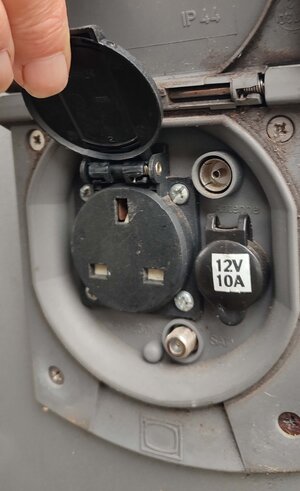
Fortunately our caravan has a factory fitted 3 pin external awning side socket.
 
I my case the 230V socket within the housing will be removed and a plastic plate with an electrical gland in it will be fitted to accommodate the wires. Also the embossed "16A/230V" writing will be removed. For simplicity the wires from the other side of the caravan where the battery incoming wires are will be run underneath the caravan fitted in flexible trunking
 

TRENDING THREADS

Latest posts

Back
Top