Battery Charging Advice Please

Mar 17, 2020
565
427
11,135
After my last service I was told the battery charger was working but not pushing much juice through. Had I been informed during the service I think I would have asked for a replacement but I missed that boat. The battery is quite new and I wasn't told there were any problems with it and, I presume, its state of charge.

I have an electric Thule Omnistore fitted to the van, with hand crank if the motor fails of course, but would like to think that reliable electrical feed is available.

Simple question for members understanding caravan electrics: I have a CTEK smart charger with "croc. clips" to fix to a battery.

Would there be any problems (if charging issues occur whilst away on EHU) with simply attaching the CTEK to the battery with the provided clips and without changing anything else with the van electrics, plug it in to provide a reliable charge?
 

JTQ

May 7, 2005
4,228
1,950
20,935
Though not claiming to be a specialist in this, I would not risk having both the CTEK and inbuilt charger both together trying to charge the battery .
I suspect it will not do any harm, but as said would not invite it to try.

I would contrive one way or other to overnight just have the CTEK charging. A way might be remove the mains fuse in the inbuilt charger, or pull its mains plug if one is used, or even disconnect the EHU from the van and connect it just to the CTEK. Fortunately I can do this at home should I want to.

Before ever doing it I would research if the inbuilt charger is smart and also test to check it is if faced with concerns I had a charging issue.
 
Apr 23, 2024
669
534
1,135
Hi JohnB
The charger /PSU wont push much juice into a nearly full or full battery, thats how it works
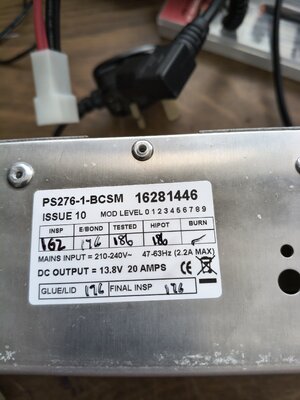
As the battery voltage rises up to 14.2V ( or on simple 1 stage chargers like the PS276or the Nordelettronica ones 13.8V) the charge current slowly reduces to less than 0.5 Amps . Connecting a CTek charge will not 'upset' the inbuilt charger, it will merely think the battery is fully charged and its output current will fall to 0 Amps the Cteck charger will continue to charge the battery upto 14.2V ( bulk charge) and then let it settle back to 13.8V (float charge)The inbuilt charger will take some current but it won't harm it , its merely running the output circuitry and feedback components , telling the driver stage not to produce any power . The service tech may not have fully understood how chargers work . When checking both the battery and inbuilt chargers I disconnect the battery and place a load of about 100-200A on it whilst observing the the voltage ,if it drops away quickly from about 11 to 11.4V ( say to 10.6V or less) then the battery is on its way out. If it holds at 11V for 30 seconds or more then its OK , but during that test I have taken quite a significant amount of charge out of the battery. Then I reconnect the charger and using a D.C clamp ammeter and digital multimeter observe the charge current and rising voltage , if I get about 9A initially and falling away as the battery voltage climbs back to 13.8V the charger is OK , Usually the inbuilt charger/PSU will fail completely rather than lose output capability( I have several dead ones of various types laying around my workshop). Conversely I have had one or two which have lost regulation and 'boiled' the battery by not shutting off at 14.2V - The usual telltale is the client has reported a 'bad egg' smell near the battery box.Some older charger/PSUs only can supply 12 Amps , where as newer ones like the the PX310 or the Victron Blu smart 12/20 can deliver 20A , but again if just charging the battery , the current will be lower.
 
  • Like
Reactions: Johnb
Mar 17, 2020
565
427
11,135
Thanks for the advice - much appreciated.

I'll probably leave the charger as it is until much later in the year.

(Reading the comprehensive reply from Ian above (thank you Ian) then maybe the on-board charger is working as it should - although my service guy is very thorough and certified AWS)

I have holidays planned including the usual extended European trip so to have the option of popping the CTec on is a bonus and will tide me over.

Again help much appreciated.
 
Apr 23, 2024
669
534
1,135
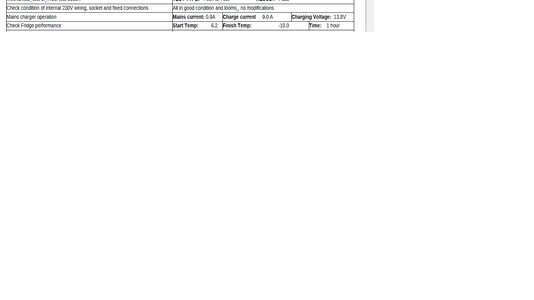
Did your AWS certified service engineer just complete the service form with 'ticks' ( about as much use as a chocolate fireguard)or actually he/she detail what the charging currents and voltages were and if so what was he comparing the 'performance' with? I was taught that when completing service reports or commision /validation sheets that the values measured were to be recorded and ticks were not allowed as it conveyed no information on the result of the test/inspection. Attached is a section of service report which I complete , this allows either me or the next service engineer at the next service to see if the performance or things like the friction pad adjustment have altered since the last inspection.IMO caravan owners should insist on actual values on service sheets ( and that includes cars!) Isee so many caravans that have been service every year ( complete with AWS stickers) and the brakes are way out of adjustment, but the service sheets say ' brakes checked -(tick)
 

Attachments

  • Extract of service report-001.jpg
    Extract of service report-001.jpg
    55.4 KB · Views: 10
Nov 11, 2009
26,023
9,651
50,935
I’ve never had anything like Ian’s description on caravans, just the AWS schedule with ticks, and sometimes notes if something wasn’t okay.
 
Jul 15, 2008
3,938
1,139
20,935
....my advice to the OP is to buy a multimeter.
From the questions asked I'm guessing he hasn't got one.
With one he could check the battery state of charge, rate of discharge, charger output etc.
YouTube videos will explain how to use one if needed.
£5 to £20 every caravanner should have one.
 
Mar 17, 2020
565
427
11,135
Good advice indeed - and I do have one. The problem is I'm not an expert and consequently not confident I'm measuring what needs to be measured!

I've not, so far, investigated using the multimeter, partly because of the above admission, but also because I listened to what the service engineer told me and that's resulted in this thread! (And nor is the van here at the present)

My presumption is that I can test the battery voltage at rest simply by using the multimeter - I can do that!
I can also turn off the mains and see if the voltage changes - if it drops then I presume any difference will be the charger working? At least that's my amateur presumption.

However, the van has a solar panel and I'm not sure if that's going to influence the reading - basically it's acting like a charger of course. There's a solar unit thingy in one of the top caravan cupboards so, when I can get to the van, I'll see if I can turn it off there.

Does this make sense please?

The only other confusing thing is what Ian has highlighted. What exactly are the readings to expect?

So far as I understand it the battery at rest and disconnected should be showing a voltage of 12.7V or more. That's fully charged. 12.5V indicates 75% charged and 12V or less means a shopping trip!

Again my understanding is that the charger, both on-board and solar, will push out current according to the state of the battery. Therefore this would vary significantly between a fully charged battery and a, lets say, one showing only 12.4V when at rest.

So far as I know my assumptions above are pretty well ok? Please advice if not and what to do about it?

Otherclive, to be fair the report is very comprehensive but it's in the van and at the moment the van is not here. He even mentioned the fact that the screws holds the external gas outlet mount had cracked the plastic - however there's enough sikaflex to be confident nothing will part!

I will check using the multimeter when able but so far as I understand it readings will vary according to what's actually happening at the time. Again, any indication of expected readings would be welcome.
 
  • Like
Reactions: Mel

JTQ

May 7, 2005
4,228
1,950
20,935
The "real" short coming most of us face in checking a battery is doing it under a heavy load, that without the right kit is difficult to achieve and is so really telling.

Crude garages have a basic shorting resister integrated with a meter, that kit really applies a heavy draw. But that automotive focused kit is not suited if we have a genuine deep discharge type of battery as these are not designed for the heavy drains these devices inflict; for our batteries, if they are genuine deep discharge type need a computerised bit of kit to do this test.

Many will of course have sudo deep cycling [leisure batteries], these can take quite high drains but at the expense of being optimised for deep cycling. In many cases where our usage does not require deep cycling , like always having a EHU, then those batteries are fine, possibly the better choice. The wider spread of quite high wattage solar systems again helps in reducing our need for deep cycling, so makes choosing a leisure battery more viable even for those going off grid..

Basically, our movers tell us as readily as most kit at our disposal if our battery is getting dicky, if the mover starts cutting out when in use, particularly like climbing our ramps or other more demanding tasks, it's thinking time, give the battery a full charge and see how it goes, get it correctly tested, or cut your odds and invest in another.
 
Last edited:
Mar 17, 2020
565
427
11,135
Just add to my last post and after thinking a bit more! (please, no comment needed:rolleyes:).

If I disconnect the terminals from the battery outside the van then the wires to the terminals will include, as well as the big heavy duty ones, another pair that carry the charger current into the battery. I could test with the multimeter there I imagine but again, what reading would indicate a properly working charger?
 

JTQ

May 7, 2005
4,228
1,950
20,935
Even without disconnecting can you not simply pull the solar systems fuse and then check with the charger on and off?
I would also have a bit of load on whilst doing the test, say a vent or heater fan running.

You need the voltage to lift when on the charger, needing IMO to see at least 13.8 but all depends on how smart the charger is and what state the battery is in [SoC].
Seeing 14.4 volts directly on the battery posts would indicate it most likely has a smart charger, but again recheck several hour later that it has backed off as it should during the float stage.
 
  • Like
Reactions: Johnb
Mar 17, 2020
565
427
11,135
Even without disconnecting can you not simply pull the solar systems fuse and then check with the charger on and off?
I would also have a bit of load on whilst doing the test, say a vent or heater fan running.

You need the voltage to lift when on the charger, needing IMO to see at least 13.8 but all depends on how smart the charger is and what state the battery is in [SoC].
Seeing 14.4 volts directly on the battery posts would indicate it most likely has a smart charger, but again recheck several hour later that it has backed off as it should during the float stage.

Thanks for this. I seem to have a lot to check when I have the van back.

As pointed out earlier the figures vary according to "what's going on" so there's no "this is fine" straighforward answer.

At least if the voltage at the battery terminals increases with the van charger switched on then some current is flowing - just a matter of degree and there seems to be no definitive number (understandably) for this.

I can, and will, measure charger direct output at the leads that connect to the battery terminal. But again, what figure to expect is not really clear. According to Google a functioning charger should read around 14.1v to 14.4v when tested with the multimeter at the battery terminals whilst connected to mains.

Maybe this is the test my service man made which, since it's only reading a direct charge from the on-board charger (and therefore sidesteps the many factors that can influence the numbers read elsewhere), it has real meaning.

Should the reading be lower than 14.1v by a significant amount then maybe I should worry - but what is that "significant" reading - under 13.8v you say?

I'm certainly going to carry the CTEK with me as a safeguard should things go pear-shaped! However it's by no means certain that will happen.
 
Dec 27, 2022
728
504
5,135
Lots of caravans are fitted with things that are called chargers but are not. They are just fixed voltage PSU delivering 13.5V /13.8V this will keep the battery topped up and allow items in the van to run but won't even get close to fully charging the battery.
Another thought unless you have just turned a smart charger on then it may well have dropped back to float

What I am trying to say is don't be surprised with the "charger" on if it's only reading 13.5V
 
  • Like
Reactions: Johnb
Nov 6, 2005
9,437
3,925
30,935
Lots of caravans are fitted with things that are called chargers but are not. They are just fixed voltage PSU delivering 13.5V /13.8V this will keep the battery topped up and allow items in the van to run but won't even get close to fully charging the battery.
Another thought unless you have just turned a smart charger on then it may well have dropped back to float

What I am trying to say is don't be surprised with the "charger" on if it's only reading 13.5V
The OP hasn't given the age, make and model of their caravan - caravans changed from up to 13.8v power supplies to up to 14.4v smart chargers some time between 2001 and 2013, going by my caravans, so it's only older caravans that will have power supplies rather than smart chargers.

My old 2001 Bailey Pageant very conveniently had a switched version of the Zig power supply which could be isolated and use a smart charger instead which was only 3.6 amp but coped fine over a 24 hour period with the battery taking the load during the day.
 
  • Like
Reactions: otherclive
Dec 27, 2022
728
504
5,135

The OP hasn't given the age, make and model of their caravan - caravans changed from up to 13.8v power supplies to up to 14.4v smart chargers some time between 2001 and 2013, going by my caravans, so it's only older caravans that will have power supplies rather than smart chargers.
I'm afraid that isn't always the case certainly not for Elddis.
If you have a charger you normally can't use it without a battery fitted.
My 2017 Affinity 554 was fitted with a 13.8vPSU as I suspect many are. Just picked it out of the bin checked the voltage
13.785V.

1000005623.jpg

That's why I fitted a Victron charger/PSU
 

JTQ

May 7, 2005
4,228
1,950
20,935
According to Google a functioning charger should read around 14.1v to 14.4v when tested with the multimeter at the battery terminals whilst connected to mains.
This is right for a "smart" charger, but as others are also rightly pointing out lots of van's had, and some possibly still are made with a power supply unit that is a compromise [say budget] solution that serves to provide just enough voltage to charge the battery and provide power for the "12" volt system, as a single "act".

These only put something like 13.8 volts on the battery posts, and just the same voltage to the van's "12 V DC" outlets etc. Basically a "dumb" unit.

Better solutions, look to putting 14.4 [about] volts on the battery posts when that can optimise the charging, but only provide 13.8 V [about] to all the van's "12 V DC" services. These are termed "smart" chargers in that they optimise both the way the battery is charged and maintained.

Presently, we don't know what you have fitted, so can't yet indicate what you should see at the various times reflecting the amount of energy the battery has taken onboard. As the battery fills up the voltages change, with a "smart" charger in a managed way to speed up the process and then to ease to a healthy voltage to optimise its longevity.

Probably an over simplification, agreed, and voltage levels not reflecting all cases but of the right order to "paint the picture" .
 
Dec 27, 2022
728
504
5,135
A smart charger generally has 3 phases some say more but these are the three that matter:
Figures are for open cell LA battery.

Bulk phase rising from rested voltage to 14.4v at max current
Absorption phase constant 14.4V reducing current
Float 13.8V current as required depending on load.

So one can see if the charger has been on for a while it may well only read 13.8V
 
  • Like
Reactions: JTQ
Nov 6, 2005
9,437
3,925
30,935
A smart charger generally has 3 phases some say more but these are the three that matter:
Figures are for open cell LA battery.

Bulk phase rising from rested voltage to 14.4v at max current
Absorption phase constant 14.4V reducing current
Float 13.8V current as required depending on load.

So one can see if the charger has been on for a while it may well only read 13.8V
Smart chargers can have 3 or more stages, often as high as 8 stages - but you're right to highlight that in float mode they'll output 13.8v, the same as a dumb power supply.
 
Dec 27, 2022
728
504
5,135
Smart chargers can have 3 or more stages, often as high as 8 stages - but you're right to highlight that in float mode they'll output 13.8v, the same as a dumb power supply.
Anything above 3 or 4 at a push ( Victron storage mode) is marketing and does almost zilch to improve the charging. A classic is Victron Adaptive charging it does nothing to improve the charging of a battery, in face it can make it worse😱
 
Apr 23, 2024
669
534
1,135
The PS 276 will work as a PSU without a battery fitted. I've repaired quite a few of these over the years and I test the repaired units using a constant current load unit which can sink up to 15A .The PS276 is a single stage power supply and is prone to overheating the internal dummy load ( a 5W resistor or on early model 2x 1W resistors) when there isn't a significant load on it which can, over time can damage the copper tracks on the PCB. On the ones I've repaired,the high voltage storage capacitor or the drive transistor usually have let go, taking out the internal 5A PCB fuse. I modify the units by clamping the load resistor to the side casing and add a thermal switch which activates the cooling fan as well the output current trigger which activates the cooling fan when the output current rises above a set value.
 
  • Like
Reactions: GUMPY

TRENDING THREADS

Latest posts