
-
We’re currently investigating an issue related to the forum theme and styling that is impacting page layout and visual formatting. The problem has been identified, and we are actively working on a resolution. There is no impact to user data or functionality, this is strictly a front-end display issue. We’ll post an update once the fix has been deployed. Thanks for your patience while we get this sorted.
You are using an out of date browser. It may not display this or other websites correctly.
You should upgrade or use an alternative browser.
You should upgrade or use an alternative browser.
Elddis and Hymer
Page 2 - Passionate about caravans & motorhome? Join our community to share that passion with a global audience!

I think it went a lot deeper Clive.It wasn’t the windows that caused failure it was square cut outs of the ADF, and escape hatch combined with a very flexible lightweight structure. These findings came from tank tests and further examination of the remains recovered from the sea. The windows were changed during the aircraft’s re-design following the two major crashes from altitude.
There’s a good programme on the investigation of the crashes “ A great British air disaster”
The cause of two of the accidents were as you describe.
But the real lesson was a number of factors.
Aluminium skin too thin.
No understanding of repeated stress cycles.
Square windows cause stress concentration, exactly like the radio radar domes that failed.All punched and screwed holes building in an inherent crack propagater.
No crack stoppage system.
Sadly by the time us Brits revised the air frame, discarding all square orifices , thicker alloys, the Boeing 707 was airborne , learning all the engineering pitfalls from us😢
Worth a read like your suggestion

An interesting article, but your comment wrt the 707 learning the lessons isn't strictly aligned with events. The 707 went airborne almost exactly at the time of the two major Comet losses and had circular windows. On one test flight the test pilot even barrel rolled it! Notwithstanding the Comet's accidents, Boeings success was down to economics with a higher passenger load, ease of maintenance, especially engine access and swop out. It was more attractive to airlines. When I was in Canada I used the Canadian Forces 707 shuttle a number of times. A great feeling as Anne Murray's "Snowbird" can over the PA system as the pilot hit the throttles, and that thing rocketed down the runaway and up. Almost as good as the RAF's VC 10s and you sat facing forwards in the 707 too.I think it went a lot deeper Clive.
The cause of two of the accidents were as you describe.
But the real lesson was a number of factors.
Aluminium skin too thin.
No understanding of repeated stress cycles.
Square windows cause stress concentration, exactly like the radio radar domes that failed.All punched and screwed holes building in an inherent crack propagater.
No crack stoppage system.
Sadly by the time us Brits revised the air frame, discarding all square orifices , thicker alloys, the Boeing 707 was airborne , learning all the engineering pitfalls from us😢
Worth a read like your suggestion
Last edited:
Those comments are at variance from my knowledge and what I have read. It is well documented the Comet commenced flights in 1952 and the 707 in 1958..
Whilst not a fan of AI what do you think of the following?
Hutch is our Aviation expert and may well have a technical view . Please no more black cats🙀
The Boeing 707 was significantly more advanced than the de Havilland Comet, marking a leap from the experimental first generation of jets to the economically viable, mass-market era of aviation. While the Comet was the world's first jetliner (1952), it was plagued by structural failures, whereas the 707 (1958) utilized lessons from those failures and superior design to become the dominant, safer, and more efficient,, long-range aircraft
.
The Boeing 707 was more advanced in the following key areas:
1. Structural Safety and Engineering
2. Aerodynamic and Engine Design
3. Performance, Range, and Capacity
4. Commercial Viability
Whilst not a fan of AI what do you think of the following?
Hutch is our Aviation expert and may well have a technical view . Please no more black cats🙀
The Boeing 707 was significantly more advanced than the de Havilland Comet, marking a leap from the experimental first generation of jets to the economically viable, mass-market era of aviation. While the Comet was the world's first jetliner (1952), it was plagued by structural failures, whereas the 707 (1958) utilized lessons from those failures and superior design to become the dominant, safer, and more efficient,, long-range aircraft
.
The Boeing 707 was more advanced in the following key areas:
1. Structural Safety and Engineering
- Failed-Safe Design: Following the catastrophic, fatal structural failures of the early Comet 1s due to metal fatigue around square windows, Boeing designed the 707 with a "fail-safe" structure.
- "Guillotine" Testing: Boeing subjected the 707 fuselage to rigorous testing, including simulating damage to ensure the skin would not rip open from small cracks (fatigue).
- Thicker Skin: The 707 was built with stronger, thicker-gauge metal skin, avoiding the weight-saving, thin-skin issues of the early Comet.
2. Aerodynamic and Engine Design
- Podded Engines: The 707 moved the engines from being buried in the wing roots (like the Comet) to pods under the wings. This allowed for easier maintenance, less risk to the wing structure if an engine failed, and easier upgrading to more powerful engines later.
- Advanced Wing Sweep: The 707 featured a 35-degree swept wing designed for higher cruising speeds and better efficiency at high altitudes, drawing from Boeing’s experience with the B-47 and B-52 bombers.
- Improved Aerodynamics: The 707 was more aerodynamically advanced and faster than the Comet.
3. Performance, Range, and Capacity
- Massive Capacity Leap: The early Comet 4 held around 81 passengers, while the 707 could carry up to 189 passengers. This allowed for a much lower cost per seat-mile, making it more profitable.
- True Transatlantic Range: The 707 was designed for, and achieved, non-stop, high-speed, transatlantic, and transcontinental capabilities. While the Comet 4 eventually achieved this, it struggled with range early on, often needing refueling stops.
- More Powerful Engines: The 707 used engines with up to 17,000 lbs of thrust, significantly more powerful than the 10,500 lbs thrust on the Comet 4, allowing for faster speeds (nearly 600 mph).
4. Commercial Viability
- Lower Operating Costs: Due to its larger capacity and more efficient design, the 707 was far more economical for airlines to operate.
- The "Jet Age" Standard: The 707 became the industry standard for cabin comfort, featuring better pressurization and a quieter, smoother, and more stable cabin environment than its competitors.
You are talking entry in to commercial service but the 707 prototype flew in 1954 at close to the time of the Comet disasters. And that’s not AI generated.Those comments are at variance from my knowledge and what I have read. It is well documented the Comet commenced flights in 1952 and the 707 in 1958..
Whilst not a fan of AI what do you think of the following?
Hutch is our Aviation expert and may well have a technical view . Please no more black cats🙀
The Boeing 707 was significantly more advanced than the de Havilland Comet, marking a leap from the experimental first generation of jets to the economically viable, mass-market era of aviation. While the Comet was the world's first jetliner (1952), it was plagued by structural failures, whereas the 707 (1958) utilized lessons from those failures and superior design to become the dominant, safer, and more efficient,, long-range aircraft
.
The Boeing 707 was more advanced in the following key areas:
1. Structural Safety and Engineering
- Failed-Safe Design: Following the catastrophic, fatal structural failures of the early Comet 1s due to metal fatigue around square windows, Boeing designed the 707 with a "fail-safe" structure.
- "Guillotine" Testing: Boeing subjected the 707 fuselage to rigorous testing, including simulating damage to ensure the skin would not rip open from small cracks (fatigue).
- Thicker Skin: The 707 was built with stronger, thicker-gauge metal skin, avoiding the weight-saving, thin-skin issues of the early Comet.
2. Aerodynamic and Engine Design
- Podded Engines: The 707 moved the engines from being buried in the wing roots (like the Comet) to pods under the wings. This allowed for easier maintenance, less risk to the wing structure if an engine failed, and easier upgrading to more powerful engines later.
- Advanced Wing Sweep: The 707 featured a 35-degree swept wing designed for higher cruising speeds and better efficiency at high altitudes, drawing from Boeing’s experience with the B-47 and B-52 bombers.
- Improved Aerodynamics: The 707 was more aerodynamically advanced and faster than the Comet.
3. Performance, Range, and Capacity
- Massive Capacity Leap: The early Comet 4 held around 81 passengers, while the 707 could carry up to 189 passengers. This allowed for a much lower cost per seat-mile, making it more profitable.
- True Transatlantic Range: The 707 was designed for, and achieved, non-stop, high-speed, transatlantic, and transcontinental capabilities. While the Comet 4 eventually achieved this, it struggled with range early on, often needing refueling stops.
- More Powerful Engines: The 707 used engines with up to 17,000 lbs of thrust, significantly more powerful than the 10,500 lbs thrust on the Comet 4, allowing for faster speeds (nearly 600 mph).
4. Commercial Viability
In summary, the 707's design allowed for easier engine upgrades, greater passenger capacity, and, most importantly, a safer structural philosophy, making it the superior, more durable, and more popular aircraft compared to the Comet.
- Lower Operating Costs: Due to its larger capacity and more efficient design, the 707 was far more economical for airlines to operate.
- The "Jet Age" Standard: The 707 became the industry standard for cabin comfort, featuring better pressurization and a quieter, smoother, and more stable cabin environment than its competitors.
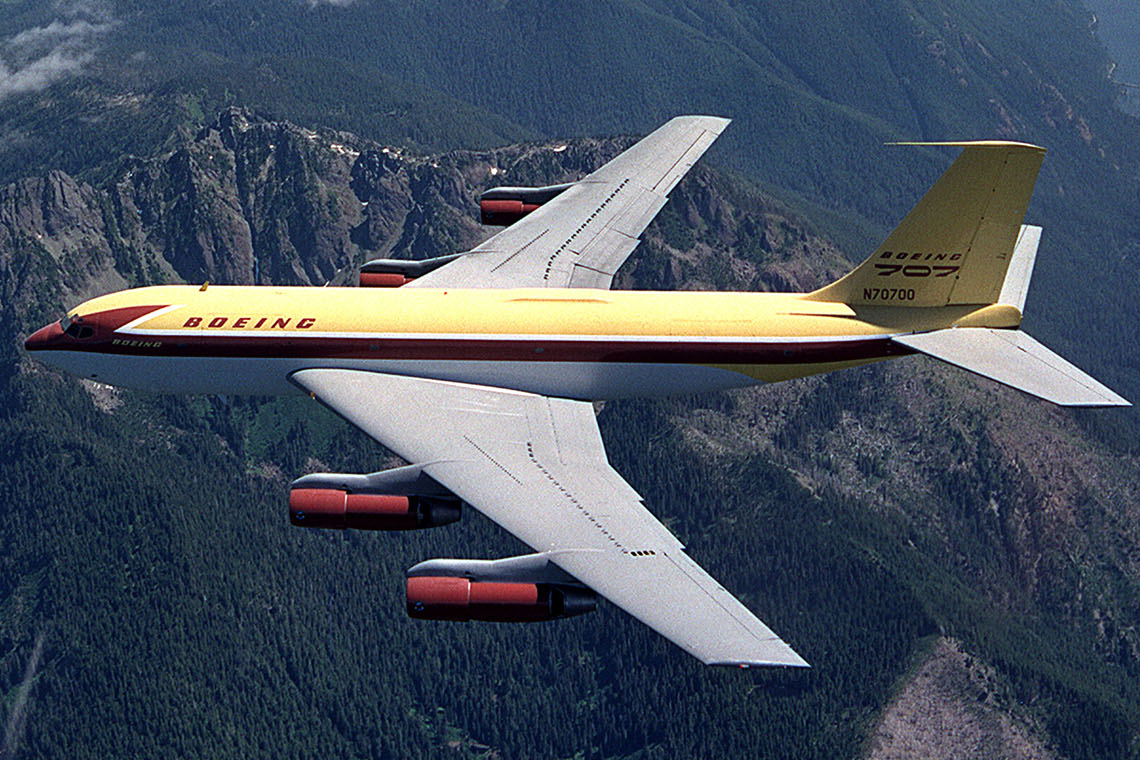
Boeing 367-80 - Wikipedia
Last edited:
The Comet prototype flew 5 years earlier - given the pace of development during and after WW2 the 707 was a generation further on.You are talking entry in to commercial service but the 707 prototype flew in 1954 at close to the time of the Comet disasters. And that’s not AI generated.
Boeing 367-80 - Wikipedia
en.wikipedia.org
While the Comet had flaws, it also had potential forming the basis for Nimrod.
That was a success but still suffered the limitations inherent from the original design and manufacture. When MOD started to upgrade Nimrod they found that no two planes were alike and basically each was bespoke in many structural areas, such that the cost estimate of upgrading the fleet went through the roof. Hence the decision to scrap the Nimrods and buy Poseidons based on the Boeing 737.The Comet prototype flew 5 years earlier - given the pace of development during and after WW2 the 707 was a generation further on.
While the Comet had flaws, it also had potential forming the basis for Nimrod.

The Nimrod had 4 different variants.That was a success but still suffered the limitations inherent from the original design and manufacture. When MOD started to upgrade Nimrod they found that no two planes were alike and basically each was bespoke in many structural areas, such that the cost estimate of upgrading the fleet went through the roof. Hence the decision to scrap the Nimrods and buy Poseidons based on the Boeing 737.
| Type | Role | Number Built | Notes |
|---|---|---|---|
| HS.801 | Prototype | 2 | Built using redundant Comet 4 airframes |
| MR.1 | Anti-submarine Warfare | 46 | |
| R.1 | Signals Intelligence | 4 | One converted from MR.2 |
| MR.2 | Anti-submarine warfare | 35 | Modernised MR.1 aircraft |
| AEW.3 | Airborne early warning | 11 | Converted from redundant MR.1 aircraft; project cancelled |
| MRA.4 | Anti-submarine warfare | 5 | Converted from MR.2; 21 planned; project cancelled |
We had a Comet 3b at RAE Bedford for the BLEU, (Blind Landing Experimental Unit) which subsequently had its tail taken off by a BEA trident.
Last edited:
I saw a piece of one of the crashed comets in the engineering school at RAF Cranwell they said the windows being squarish had caused the failure but more evidence emerged later ,but as it was the first passenger jet airliner (1949 compared with the 707 - 1957) it probably was a steep learning curve about stresses in pressurised jet liners( the Dakota was unpressurised the B29 was the first pressurised bomber) Back in WW2 the liberty ships had welded square hatch coamings and the stress and cold at the corners of them caused cracks to form in the decks , but again they were built quickly and not expected to last very long. Engineer have known for a long time that corners are always high stress points .
The front and rear panels of caravans I've worked on haven't been part of the main structure , behind them is always a framed wall with , but the that construction does lack rigidity a lot of the rigidity of a caravan comes from the furniture inside . the Front and rear wooden/polystyrene assemblies are offered up the caravan and screwed to the side wall ( four screws per side), then the ABS/Fibreglass front is offered up and screwed and the awning rail fitted to cover the joints. On Elddis Xplore's there is no rear outer plywood skin , if you drill a hole into the rear ABS panel you will see a 50-75mm void and the framing and polystyrene , the only place the rear ABS panel touches this rear wall is if a rear window is fitted. the Framing doesn't look capable of preventing the rear wall from distorting when being towed, but hopefully the designers at Elddis are learning from their mistakes just as any good engineer should
The front and rear panels of caravans I've worked on haven't been part of the main structure , behind them is always a framed wall with , but the that construction does lack rigidity a lot of the rigidity of a caravan comes from the furniture inside . the Front and rear wooden/polystyrene assemblies are offered up the caravan and screwed to the side wall ( four screws per side), then the ABS/Fibreglass front is offered up and screwed and the awning rail fitted to cover the joints. On Elddis Xplore's there is no rear outer plywood skin , if you drill a hole into the rear ABS panel you will see a 50-75mm void and the framing and polystyrene , the only place the rear ABS panel touches this rear wall is if a rear window is fitted. the Framing doesn't look capable of preventing the rear wall from distorting when being towed, but hopefully the designers at Elddis are learning from their mistakes just as any good engineer should
Thank you for getting us back on track.I saw a piece of one of the crashed comets in the engineering school at RAF Cranwell they said the windows being squarish had caused the failure but more evidence emerged later ,but as it was the first passenger jet airliner (1949 compared with the 707 - 1957) it probably was a steep learning curve about stresses in pressurised jet liners( the Dakota was unpressurised the B29 was the first pressurised bomber) Back in WW2 the liberty ships had welded square hatch coamings and the stress and cold at the corners of them caused cracks to form in the decks , but again they were built quickly and not expected to last very long. Engineer have known for a long time that corners are always high stress points .
The front and rear panels of caravans I've worked on haven't been part of the main structure , behind them is always a framed wall with , but the that construction does lack rigidity a lot of the rigidity of a caravan comes from the furniture inside . the Front and rear wooden/polystyrene assemblies are offered up the caravan and screwed to the side wall ( four screws per side), then the ABS/Fibreglass front is offered up and screwed and the awning rail fitted to cover the joints. On Elddis Xplore's there is no rear outer plywood skin , if you drill a hole into the rear ABS panel you will see a 50-75mm void and the framing and polystyrene , the only place the rear ABS panel touches this rear wall is if a rear window is fitted. the Framing doesn't look capable of preventing the rear wall from distorting when being towed, but hopefully the designers at Elddis are learning from their mistakes just as any good engineer should
Comparing like with like the first Comet flew in July 1949, and the first 707 in July 1954. It was designated Dash80, or 367-80 but had 707 painted on its tail plane. It’s now in the Smithsonian along with many other interesting exhibits.Thank you for getting us back on track.
May I cheekily ask, do we know they have they one, an "engineer" or hopefully more than one? 😉 [It worked better where bouncing ideas around peers was practiced]the Framing doesn't look capable of preventing the rear wall from distorting when being towed, but hopefully the designers at Elddis are learning from their mistakes just as any good engineer should
More generally, sadly, these seemed to be getting pretty short on the ground in my latter consulting years, great for getting commissions though.
It had become far from the UK of old where excellent engineering companies, government research establishments and associated training was the norm to be found in nearly every principal town. An ideal generating house for engineering design skills.
Last edited:
The problem with caravans is that the quest to keep the weight and cost down results in low stiffness which then constantly flexes when being towed - ABS can't cope with that flexing.I saw a piece of one of the crashed comets in the engineering school at RAF Cranwell they said the windows being squarish had caused the failure but more evidence emerged later ,but as it was the first passenger jet airliner (1949 compared with the 707 - 1957) it probably was a steep learning curve about stresses in pressurised jet liners( the Dakota was unpressurised the B29 was the first pressurised bomber) Back in WW2 the liberty ships had welded square hatch coamings and the stress and cold at the corners of them caused cracks to form in the decks , but again they were built quickly and not expected to last very long. Engineer have known for a long time that corners are always high stress points .
The front and rear panels of caravans I've worked on haven't been part of the main structure , behind them is always a framed wall with , but the that construction does lack rigidity a lot of the rigidity of a caravan comes from the furniture inside . the Front and rear wooden/polystyrene assemblies are offered up the caravan and screwed to the side wall ( four screws per side), then the ABS/Fibreglass front is offered up and screwed and the awning rail fitted to cover the joints. On Elddis Xplore's there is no rear outer plywood skin , if you drill a hole into the rear ABS panel you will see a 50-75mm void and the framing and polystyrene , the only place the rear ABS panel touches this rear wall is if a rear window is fitted. the Framing doesn't look capable of preventing the rear wall from distorting when being towed, but hopefully the designers at Elddis are learning from their mistakes just as any good engineer should
The answer is not to use ABS for full-height panels and restrict it's use to mouldings for lights and number plates.
TRENDING THREADS
-
-
-
 Just noticed we have a small crack in the middle of window on awning side from the top (at rear)
- Started by Beachball
- Replies: 10
-
 Mandatory eye tests for drivers over 70 being proposed by HMG. Good or bad?
- Started by Dustydog
- Replies: 230
-
-
-
Vision Plus Long Mast Pole - Swift Challenger 580 (2017)
- Started by Weebo
- Replies: 3
