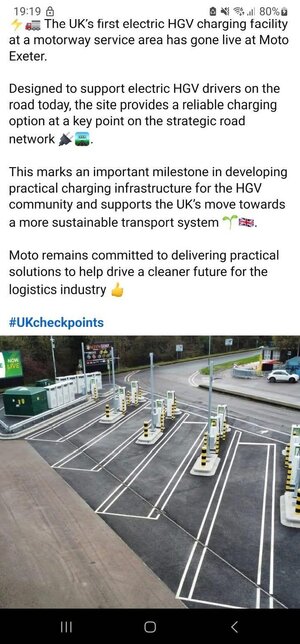
I think HGV will be around 350 kw but with the aim being 1 mw supply. Mind you when solid state car batteries start to appear range will be potentially twice that of lithium based batteries, or same range for a smaller battery. Much reduced fire risk and faster charging too. So I suspect caravanners may not be so range inhibited as SSB enter the market. Although those that do high miles per day with a van might still have to decouple.I honestly don’t know so the answer hence the question.
Does the plug in EV lead have the same configuration for a HGV as for a domestic electric car?
Mel
Not many, but having charging facilities is an essential prerequisite for increased usage. Plus future emmisions controls will drive the uptake in years ahead.I wonder just how many Large E HGVs are out there?
That has already been killed off as many probably would not like to be paying the per miles charge on an EV? Many current HGV clock up 100's of thousands of miles before they are taken off the road. Some probably get to a million miles or so before being retired.I wonder just how many Large E HGVs are out there?
But will HGV be pay per mile?That has already been killed off as many probably would not like to be paying the per miles charge on an EV? Many current HGV clock up 100's of thousands of miles before they are taken off the road. Some probably get to a million miles or so before being retired.
Probably if it is an EV. Only the current government knows. Merry Christmas to you.But will HGV be pay per mile?
The mileage tax is to replace Treasury income for reduced fuel duty - we're going to have to pay it one way or the other.Our local Authority have been using an E HGV dustcart for bin collections. It can only cover 2/3rds distance of its diesel siblings. This means it takes one half longer to complete the same diesel round. More employees are needed so any power cost savings are eroded.
Applying a mileage tax will make the whole situation worse and ultimately the rates payer will pick up,the tab