The pavement in front of my house rises up from the road and then drops away down my drive. It means that when I reverse my Bailey Phoenix onto the drive I always end up with the back wall of the caravan hitting the ground as the wheels come over the lip formed by the drive. I read about a project ages ago where small wheels were fitted to the rear steadies so when they are reclined the wheels would hit the ground before the back wall does and the impact would be avoided. I cant find the article about this anywhere even though I've gone through all my old editions. Has anyone else done this as it would seem to be a very sensible fix to my problem.

-
We’re currently investigating an issue related to the forum theme and styling that is impacting page layout and visual formatting. The problem has been identified, and we are actively working on a resolution. There is no impact to user data or functionality, this is strictly a front-end display issue. We’ll post an update once the fix has been deployed. Thanks for your patience while we get this sorted.
You are using an out of date browser. It may not display this or other websites correctly.
You should upgrade or use an alternative browser.
You should upgrade or use an alternative browser.
Rear of caravan grounds on drive
- Thread starter AdenG1
- Start date
- Status
- Not open for further replies.

This would just put a probably excessive load onto the steadies causing damage to those steadies and/or the floor.
If you are reversing with a mover, perhaps you could reverse in conjunction with the raising and lowering of the jockey wheel in order to lift the rear end clear of the hump at the appropriate time.
John
If you are reversing with a mover, perhaps you could reverse in conjunction with the raising and lowering of the jockey wheel in order to lift the rear end clear of the hump at the appropriate time.
John

I concur with JCL, fitting wheels to the rear steadies is actually more likely to cause damage.
If I have understood the configuration of your pavement and driveway correctly, the problem is the drive way slopes very steeply down from the road and as the caravan descends, the hitch on the car is very high forcing the tail of the caravan to dip further grounding the rear rail.
You either need to raise the ground under the road wheel of the caravan just before the point its likely to ground, and this might be achieved by using some paving slabs or scaffold boards on the drive and you effectively reverse the caravan wheels onto them.
If I have understood the configuration of your pavement and driveway correctly, the problem is the drive way slopes very steeply down from the road and as the caravan descends, the hitch on the car is very high forcing the tail of the caravan to dip further grounding the rear rail.
You either need to raise the ground under the road wheel of the caravan just before the point its likely to ground, and this might be achieved by using some paving slabs or scaffold boards on the drive and you effectively reverse the caravan wheels onto them.
If they can get the timing right, putting your passenger in the caravan and moving from front to rear may be sufficient to do the trick - I have the same issue although the road is lower than the shared drive so when departing my wife used to stand at the back as the A-frame went over the high point and then move to the front for the tail to get over it - the problem became much easier when I bought a car with air adjustable suspension as I can use that to alter the caravan's angle.

A more permanent and practical solution would be to install a drop kerb at the entrance to the driveway, I had no difficulty obtaining permission from my local authority in Scotland.
Example photograph below; and if living in Wales or England the information in the link may be of use.
Application for England & Wales
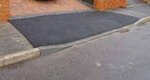
Example photograph below; and if living in Wales or England the information in the link may be of use.
Application for England & Wales

In our last house we had a dropped kerb and the van grounded. I used planks.A more permanent and practical solution would be to install a drop kerb at the entrance to the driveway, I had no difficulty obtaining permission from my local authority in Scotland.
Example photograph below; and if living in Wales or England the information in the link may be of use.
Application for England & Wales
View attachment 2298
If you don't have a mover then that might be the answer as it is much easier to see what is happening/about to happen as you move the van. Is it possible to take it in jockey wheel first as that might solve the issue? I always reverse my van off the drive (now with the mover) as I have a slight 'peak' where the driveway rises slightly to the inner edge of the kerb where there is then a standard drop kerb.
The idea was shown twice in the magazine and I have tried to find it but could not. To be honest I did wonder if castors would be strong enough for the job but do not know for sure. but I never took in the detail. Possibly if you write to the magazine they can help.
As the others have said the best bet may be a motor mover so you can adjust the jockey wheel to a lower position and that should do the trick.
As the others have said the best bet may be a motor mover so you can adjust the jockey wheel to a lower position and that should do the trick.

In our last house we had a dropped kerb and the van grounded. I used planks.
That reads like you are saying that a dropped kerb entrance offers no advantage.
No just a fact that even with a dropped kerb a 7 m van would ground. As the drop met the road the camber of the road rose, which combined with a very slight slope on the drive led to some loss of clearance. Planks plus motor mover made it possible to just move the van smoothly without further adjustments.That reads like you are saying that a dropped kerb entrance offers no advantage.

We have a drop kerb at the entrance of our driveway and caravan was okA more permanent and practical solution would be to install a drop kerb at the entrance to the driveway, I had no difficulty obtaining permission from my local authority in Scotland.
Example photograph below; and if living in Wales or England the information in the link may be of use.
Application for England & Wales
View attachment 2298
As far as I understand, its not the kerb that's the problem, its the angle of the drive which drops away too quickly relative to the pavement. Somehow the angle of the drive needs to be reduced, which points towards planks or slabs. Others have also mentioned a caravan mover which would probably be even better, but more expensive.


Mel
Moderator
Our drive at our previous house had a steep drop off and the van at the time would have grounded if we were not careful. We used a motor mover though. We also dropped the jockey wheel down as far as it would go and made sure that there was no weight loaded at the rear of the van. Used to get it in with about an inch of clearance. Didn’t seem to be such a problem on the way out. 🤔
Mel
Mel
I had rear grounding issues but not in your context, mine grounded transiting the undulations of ferry ramps, all tide etc related.
To avoid expensive damage to the van's rear panel, I set the steadies to just ground first and function as "skids". It worked albeit with a "horrible" noise and we kept that van for 11 years travelling at least once a year to the continent, doing zero harm to the van.
Just check the steadies present a cam surface to the ground that will not catch up, like those dangly plastic things do.
If it is not a seriously hard grounding case, or other than a straight pull, I doubt it amounts to much actual loading.
Castors as opposed to "skids" here will not alter the forces involved, just the noise.
As said a mover might help, at least reversing in as that enables the front end of the van to really squat down lifting the rear end, but only lower it once the jockey has castored under the hitch so not fouling the brake levers etc.
To avoid expensive damage to the van's rear panel, I set the steadies to just ground first and function as "skids". It worked albeit with a "horrible" noise and we kept that van for 11 years travelling at least once a year to the continent, doing zero harm to the van.
Just check the steadies present a cam surface to the ground that will not catch up, like those dangly plastic things do.
If it is not a seriously hard grounding case, or other than a straight pull, I doubt it amounts to much actual loading.
Castors as opposed to "skids" here will not alter the forces involved, just the noise.
As said a mover might help, at least reversing in as that enables the front end of the van to really squat down lifting the rear end, but only lower it once the jockey has castored under the hitch so not fouling the brake levers etc.
Last edited:
We also carry planks and blocks of wood just in case and so far the blocks have come in handyPlanks as suggested never fail. I carry four having been caught out on a site years ago. Also they get used for lateral levelling
I remember the article, but I also remember thinking that the chap making these mods was crazy.
I use the mover to take the van on and off my drive, which has slight incline; but I have to adjust height of the nose mid-way to avoid either the hitch or rear end grounding.
I use the mover to take the van on and off my drive, which has slight incline; but I have to adjust height of the nose mid-way to avoid either the hitch or rear end grounding.

I've a lowered path which rises to the start of my drive way, then the drive falls away. when I reverse in, and leave for that mater. I have to take it at a snails pace as the wheels lift on the kerb just before the steadies ground, at the start of the drive. Maybe some form of wedge at the edge of the path, just to lift the van a fraction.
I think I know why they were layed that way, rain water runs down the road but not down our drive.
I think I know why they were layed that way, rain water runs down the road but not down our drive.
Our present house has no kerbs at all in the close. The developers left short inclined blocks along the sides of the road. Makes it extremely difficult to park as many houses have block paved their drives so instead of a tarmac drive leading to the garage visitors will see the whole front block paved and with cars on. We are okay as we are adjacent to the turning area. I just used a length of decking board to reduce the step up to the incline blocks that edge the road. So the van eased up the decking onto a section of inclined edge block and then onto the drive which sloped down from the road end.I've a lowered path which rises to the start of my drive way, then the drive falls away. when I reverse in, and leave for that mater. I have to take it at a snails pace as the wheels lift on the kerb just before the steadies ground, at the start of the drive. Maybe some form of wedge at the edge of the path, just to lift the van a fraction.
I think I know why they were layed that way, rain water runs down the road but not down our drive.
Hi,The pavement in front of my house rises up from the road and then drops away down my drive. It means that when I reverse my Bailey Phoenix onto the drive I always end up with the back wall of the caravan hitting the ground as the wheels come over the lip formed by the drive. I read about a project ages ago where small wheels were fitted to the rear steadies so when they are reclined the wheels would hit the ground before the back wall does and the impact would be avoided. I cant find the article about this anywhere even though I've gone through all my old editions. Has anyone else done this as it would seem to be a very sensible fix to my problem.
We had the same problem,try reversing the van onto the road at an angle rather than straight,alternatively place pieces of flat wood under each wheel at the point when grounding is occurring.

I had rear grounding issues but not in your context, mine grounded transiting the undulations of ferry ramps, all tide etc related.
Ill name that tune in one, we regularly had the same issues with low loaders.
To be fair, I also carry a plank, but she aint a bad cook.
- Status
- Not open for further replies.
TRENDING THREADS
-
-
Vision Plus Long Mast Pole - Swift Challenger 580 (2017)
- Started by Weebo
- Replies: 2
-
-
 Just noticed we have a small crack in the middle of window on awning side from the top (at rear)
- Started by Beachball
- Replies: 8
-
 Mandatory eye tests for drivers over 70 being proposed by HMG. Good or bad?
- Started by Dustydog
- Replies: 230
-
-