

• We’re currently investigating an issue related to the forum theme and styling that is impacting page layout and visual formatting. The problem has been identified, and we are actively working on a resolution. There is no impact to user data or functionality, this is strictly a front-end display issue. We’ll post an update once the fix has been deployed. Thanks for your patience while we get this sorted.

Alternative battery terminal(s).

Just replaced my 'quick release' battery terminals for a type that offer 4 ports for different cable size connection options.

The quick release type (spring hinge) proved to be very usefull, I have had no problems with them at all except for the cable clamping mechanism, it was good for what I was using it for, but now I intend to have some additional wiring to add to my battery clamps and am not quite happy with the previous clamping arrangement.

So, I thought I would try these (pic below), cost about £8.50 delivered, seem very well made and so far I am reasonably happy with them.

One thing that irks me is that my battery terminals are tapered and the new clamps (and the older quick release ones) are not designed to accommodate tapered battery posts; so a less than perfect clamping force is actually applied.

If someone knows of 'sleeves' to fit tapered battery posts to accommodate the non-tapered profile of most battery clamps, please let me know.

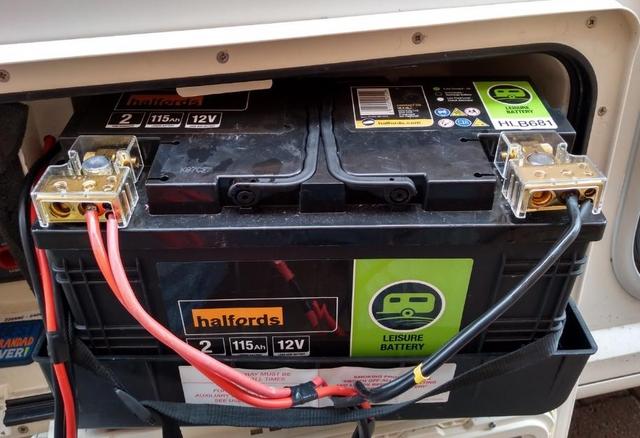
Battery-Terminals-1.jpg


Battery-Terminal-Fitted-with-covers-on.jpg
 
I looked at your type a while back when I found my conventional terminals had loosened wires. They do look useful in that seperate wires can be connected without the hassle of twisting and forcing in to a hole that’s too small.
 
I thought all battery terminals were tapered and the clamps were tapered to fit, the taper is so minimal it’s hard to see, I’m not taking the mick but have you tried the new clamp turned over?
 
Hi Beehpee,

Wheter or not there is a barely discernible taper or not I do not know as I did not try installing them upside down.

A couple of reasons I did not think of flipping them over:

1. The + & - symbols are marked on one face only.
2. If they were fitted upside down then the grub screws would not be accessible.

The new clamps are sized for + and - battery posts, so cannot be fitted to the 'wrong' post.

And I did not think you were taking the mickey bliss 😉 , my previous 'quick release' battery clamps could only be fitted one way up, and they were not a tapered fit either.
 
When I recently fitted my new Banner battery I had quite a job to get my existing terminals to fit. Even had to use a file so I could pride them open further with a large flat bladed screwdriver. Clearly there are variation in dimensions between different makes.
 
I zoomed in on your pic of the terminals after I posted and I could see the + on one of them so unlikely you’d have them on wrong terminal, might be worth turnin* them over though as the taper is so slight it’s hard to see with naked eye, grub screws don’t mater being underneath once wires are in as your not going to need to undo them once connected, just a thought.

BP
 
I faced the problem of too many cables requiring connection to the battery making life difficult.

I brought two 60 amp meter blocks from Screwfix which are now mounted adjacent to the consumer unit/charger and motor mover control inside the the caravan. The connecting cable from these to the battery are single 16mm flexible cable.
 
I don't like the clamp on posts, as I've seen too many examples in the marine environment where a bit of corrosion builds up between the clamp and posts. I like the M8 studs secured by nut and washer/spring washer, then liberally slathered in grease… Never had corrosion or loose connection, and easy to add an additional cable if required (crimp ring terminals)
 
There other side lever type clamps available that are good for tight battery boxes, that also have additional points for motor mover cables.
To add more cables, its better to take the supply from the existing incoming power cable by the battery box, and run this to separate fuse box so that the original fuse covers the new installation, and the new fuse box has the correct fuses for whatever circuits you want to install.
 

TRENDING THREADS

Latest posts

Back
Top