• We’re currently investigating an issue related to the forum theme and styling that is impacting page layout and visual formatting. The problem has been identified, and we are actively working on a resolution. There is no impact to user data or functionality, this is strictly a front-end display issue. We’ll post an update once the fix has been deployed. Thanks for your patience while we get this sorted.

Gas bottle weights

Sam Vimes

Moderator
I'm sure we've all noticed that Calor Gas bottles have marked on them the actual weight of the bottle 'sans' gas. But it's in old money of Ibs and ozs. Makes it a little tricky to work out how much gas you have because you buy it in kgs.

We've just bought a 19kg bottle for house and we use Flogas. This has the bottle weight in kgs...much more sensible in my opinion.

 
I'm sure we've all noticed that Calor Gas bottles have marked on them the actual weight of the bottle 'sans' gas. But it's in old money of Ibs and ozs. Makes it a little tricky to work out how much gas you have because you buy it in kgs.

We've just bought a 19kg bottle for house and we use Flogas. This has the bottle weight in kgs...much more sensible in my opinion.
I have no idea why Calor continue to use Imperial units on the tare weights. Apart from the fact its the way they have always done it, I am not aware of any benefit in sticking with imperial.
 
Given that SI units were introduced into British schools in 1974, and earlier at some schools and colleges I can see no earthly reason why Calor still use Imperial units. It’s not as if the gas cylinders are exported to the US.
 
I have no idea why Calor continue to use Imperial units on the tare weights. Apart from the fact its the way they have always done it, I am not aware of any benefit in sticking with imperial.
Do they stick to Imperial? My two Calorlites have the tare weight in kilos, with one decimal, stamped on the base ring.
 
My kids are in their early fifties and have known SI since they started school. So there’s a whole cohort of customers not being addressed.
Ironically, the LPG contents of Calor cylinders have been measured in kilos ever since I've been caravanning, ie over 40 years.
 
I have no idea why Calor continue to use Imperial units on the tare weights. Apart from the fact its the way they have always done it, I am not aware of any benefit in sticking with imperial.
We are British . Still MPH, Miles, Pints, Currency, Sterling, including Scottish.
 
The vast majority of products now primarily come in metric units, milk is one of the odd ones out as the containers are labelled in pints with an odd metric quantity. . Most people have long since adapted to metric without realising it, probably because they buy the product rather than buy by weight. Having visited Europe regularly since the mid 1960s we got the hang of ordering foodstuffs in metric units because asking for 8 ounce of cheese in O level French in a local market didn’t get us very far. When shopping in U.K. for loose foodstuffs we use metric, as do our kids and grandkids.
One area where SI units were a distinct advantage were my uni exams as finals questions were 50/50 Imperial and SI. The SI questions could be answered more quickly than the Imperial questions due to the more rational system of units. Effectively giving the students a time bonus.
 
The vast majority of products now primarily come in metric units, milk is one of the odd ones out as the containers are labelled in pints with an odd metric quantity. . Most people have long since adapted to metric without realising it, probably because they buy the product rather than buy by weight. Having visited Europe regularly since the mid 1960s we got the hang of ordering foodstuffs in metric units because asking for 8 ounce of cheese in O level French in a local market didn’t get us very far. When shopping in U.K. for loose foodstuffs we use metric, as do our kids and grandkids.
One area where SI units were a distinct advantage were my uni exams as finals questions were 50/50 Imperial and SI. The SI questions could be answered more quickly than the Imperial questions due to the more rational system of units. Effectively giving the students a time bonus.
What is even weirder is the odd weights in gm displayed on packaging and the vast number of sizes for a product i.e. 125gm, 230gm,340gm, 420gm 550gm 780gm, etc. Same applies when using ml. Surely if it was just 250gm, 500gm 7750gm or 1Kg it would be simpler and less packaging?

The normal excuse is that according to feedback from customers that is what they want etc.
 
What is even weirder is the odd weights in gm displayed on packaging and the vast number of sizes for a product i.e. 125gm, 230gm,340gm, 420gm 550gm 780gm, etc. Same applies when using ml. Surely if it was just 250gm, 500gm 7750gm or 1Kg it would be simpler and less packaging?

The normal excuse is that according to feedback from customers that is what they want etc.
Your approach is too logical as it would deny the producers the opportunity to reduce contents without the buyer really noticing it. Ever since covid that’s been going on.
 
What is even weirder is the odd weights in gm displayed on packaging and the vast number of sizes for a product i.e. 125gm, 230gm,340gm, 420gm 550gm 780gm, etc. Same applies when using ml. Surely if it was just 250gm, 500gm 7750gm or 1Kg it would be simpler and less packaging?

The normal excuse is that according to feedback from customers that is what they want etc.
It's bureaucratic standardisation without industrial standardisation - they invent a standard that includes all the currently used variations - a pointless exercise in my view.
 
I'm sure we've all noticed that Calor Gas bottles have marked on them the actual weight of the bottle 'sans' gas. But it's in old money of Ibs and ozs. Makes it a little tricky to work out how much gas you have because you buy it in kgs.

We've just bought a 19kg bottle for house and we use Flogas. This has the bottle weight in kgs...much more sensible in my opinion.
1000010366.jpg
I'm sure we've all noticed that Calor Gas bottles have marked on them the actual weight of the bottle 'sans' gas. But it's in old money of Ibs and ozs. Makes it a little tricky to work out how much gas you have because you buy it in kgs.

We've just bought a 19kg bottle for house and we use Flogas. This has the bottle weight in kgs...much more sensible in my opinion.
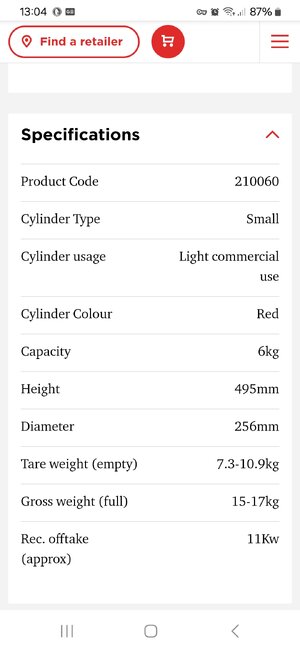
My 1st reply is of calor gas Web site, but sadly this doesn't tally with my 2 x6kg bottles. #1 is16lbs 08oz and #2 is 21lbs Tare weight ? 1 converts to 7+ kg + 6kg gas = 13kg/ #2 converts to 9+ kg + 6kg gas=15kgs full. They both weigh 26.5 kgs, how's that?
 
Bottle #1 , 7.54 kg #2 9.54 kg = 17.08 kg . Bottles weighed at 26.5 kg, means you only have 9.42 kg of gas between the two bottles.
Were these supposed to be freshly filled bottles.
 
My school was using CGS in 1963!
That’s very forward thinking since the International System of Units, SI, was only formally recognised in 1960. But it wasn’t officially introduced into British schools until 1974. My degree course in 1968 used dual units through to finals in 1971. SI was so much simpler to use than the Imperial Units.
 
That’s very forward thinking since the International System of Units, SI, was only formally recognised in 1960. But it wasn’t officially introduced into British schools until 1974. My degree course in 1968 used dual units through to finals in 1971. SI was so much simpler to use than the Imperial Units.
Between 1958 and 1963 I was taught in both metric and imperial - the metric system, on which SI is based, having been around since 1799
 
That’s very forward thinking since the International System of Units, SI, was only formally recognised in 1960. But it wasn’t officially introduced into British schools until 1974. My degree course in 1968 used dual units through to finals in 1971. SI was so much simpler to use than the Imperial Units.
I feel very mixed up because I went through every change on basic units
FPS - Foot Pound Second
CGS - Centimeter Gramme Second
MKS - Meter Kilogramme Second
and finally
SI - which is basically the MKS system rebranded.

It's amazing how often I still tend to think in FPS
 

TRENDING THREADS

Latest posts

Back
Top