• We’re currently investigating an issue related to the forum theme and styling that is impacting page layout and visual formatting. The problem has been identified, and we are actively working on a resolution. There is no impact to user data or functionality, this is strictly a front-end display issue. We’ll post an update once the fix has been deployed. Thanks for your patience while we get this sorted.

Does a motor mover really flatten the battery.

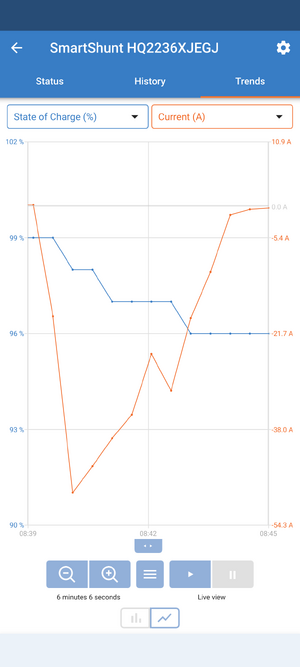
Just done a 5 minute move to get the van out of storage for its service it used 3% of battery capacity and drew a maximum of 50amps when first started.
Much less than I had been led to believe 🫣1000005722.png
 
You’ve confirmed what Prof John/RogerL has been saying for years, is that movers don’t use much battery capacity for most times of use. Of course there will be exceptions for some owners depending on their particular needs.
 
We had our caravan in storage for 3 months when we moved house. I was concerned the battery would be flat and the motor mover wouldn't work. When we went to get it the battery showed 30% and the mover worked fine.
 
Motor manufactures have to quote maximum current consumptions, so appliance designers can be sure to specify suitable motors for their products. The difficulty for electric motors is the maximum current a DC motor will draw is when it's stalled, or starting from stationary with no back EMF being generated. Most designers will ensure the motors torque will be able to driver the appliance, so it instant the motors shaft does start to turn, the back EMF ramps up and opposes the inrush current which diminishes as the shaft speed increases.

The reason most people need a reasonable sized leisure battery, is to ensure the battery has enough cold cranking amps to start a caravan mover where the wheels may need to climb a kerb. In general even a small car starter battery will have enough cold cranking amps for any mover, but the construction batteries is different and leisure batteries can stad being discharged for longer than conventional car batteries.
 
Our caravan sits on the drive by the side of the house, the drive slopes down once level with the front edge of the house - getting it off the drive is no problem and so far it’s managed the kerb and incline back up the drive without issue.
It weighs circa 1460 kgs and I have actually managed to push it up the drive on my own once ( as soon as you get it rolling it’s manageable), but it’s not something I would want to do regularly.

Just off now for my three shredded wheat🤣🤣🤣

Captain Chaos
 
Our caravan sits on the drive by the side of the house, the drive slopes down once level with the front edge of the house - getting it off the drive is no problem and so far it’s managed the kerb and incline back up the drive without issue.
It weighs circa 1460 kgs and I have actually managed to push it up the drive on my own once ( as soon as you get it rolling it’s manageable), but it’s not something I would want to do regularly.

Just off now for my three shredded wheat🤣🤣🤣

Captain Chaos
Nor is it something I would recommend! A 1.5 tonne caravan on a slope can do serious damage to humans and property.
 
Does it flatten the battery?
Rather depends on how well the battery is charged and how far you expect the mover to move the caravan over what type of surface, gradient etc. i.e. 50 yards over flat concrete or 20 yards over rough ground or up an incline.
 
Does it flatten the battery?
Rather depends on how well the battery is charged and how far you expect the mover to move the caravan over what type of surface, gradient etc. i.e. 50 yards over flat concrete or 20 yards over rough ground or up an incline.
Strictly speaking yes of course using any mover with any battery will eventually flatten the battery. But I think most of under stood the rhetorical nature of the headline in the context of the OPs included information.

The fact is you need battery that has peak current delivery to match the movers peak amperage rating to get a mover to work. In most usage scenarios, the total power (Watts Hours) consumed by the mover is often much lower than you might imagine and was well demonstrated by the OP's figures.
 
15 years ago I moved our Wyoming nearly 100 yards from pitch to pitch at Scourie for a cliff edge pitch. No be problem. In fact yhe battery afterwards on the Bailey rubbish volt meter still showed 12+ v.
Remember the Powrtouch units are low geared and once moving don't need heavy amps
 
15 years ago I moved our Wyoming nearly 100 yards from pitch to pitch at Scourie for a cliff edge pitch. No be problem. In fact yhe battery afterwards on the Bailey rubbish volt meter still showed 12+ v.
Remember the Powrtouch units are low geared and once moving don't need heavy amps
Similarly I had to resort to using the mover to remove the caravan from two very wet CLs where the ground was soaked and some surface water, and another one where the farmer had cut the grass and it had rained. In all three cases the cars ( 4wd or AWD) failed to move the van even one inch. To make it”easier” on the move in all three cases the van came off backwards with noseweight down to near zero.
 
Last edited:
In most usage scenarios, the total power (Watts Hours) consumed by the mover is often much lower than you might imagine and was well demonstrated by the OP's figures.
" Watt Hours" is not "power" but energy, and it is "energy" a battery stores. Ah [Amp x hours] x 12 volts= Watt hours.

And yes movers use far less "energy" [Ah x nominally 12volts] than many think they do.
Where it all goes wrong is our batteries as they age lose two things, their ability to store their original energy capacity, Ah*, and secondly their ability to release that energy at enough "power" Watts [Amps x nominally 12 volts].

* This ability to store the labelled energy [Ah x nominally 12 volts] decays quite drastically with any persistent abuse, and usage cycles.
Our movers with their high power requirement tend to be the first hint most of us get that our batteries have failed to do what we purchased them for, hold a requisite amount of "energy".
 

TRENDING THREADS

Latest posts

Back
Top