

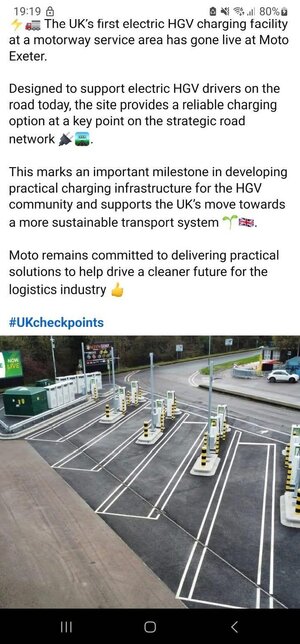
HGV E charging points
- Thread starter Dustydog
- Start date
You are using an out of date browser. It may not display this or other websites correctly.
You should upgrade or use an alternative browser.
You should upgrade or use an alternative browser.

- Sep 4, 2011
- 673
- 417
- 19,135
I think a lorry drivers language to find a car& caravan on one of them would will be unrepeatable


- Nov 11, 2009
- 25,586
- 9,370
- 50,935
I could not support a non EV outfit using them, but they should be available to EV outfits, but I doubt that they will be. After all a EV outfit can uncouple and park the caravan whilst the tow car charges its battery.

- Nov 11, 2009
- 25,586
- 9,370
- 50,935
I think HGV will be around 350 kw but with the aim being 1 mw supply. Mind you when solid state car batteries start to appear range will be potentially twice that of lithium based batteries, or same range for a smaller battery. Much reduced fire risk and faster charging too. So I suspect caravanners may not be so range inhibited as SSB enter the market. Although those that do high miles per day with a van might still have to decouple.I honestly don’t know so the answer hence the question.
Does the plug in EV lead have the same configuration for a HGV as for a domestic electric car?
Mel
A new instavolt multi bay charger near us and I’ve never seen a car plugged in yet. Because most motorists charge at home and possibly at work.
SAMSUNG SDI to Collaborate on All-Solid-State Battery Validation Project with BMW Group
<p style="line-height: 200%; text-align: center;"><span style="font-size: 14pt; font-weight: bold;">Samsung SDI, BMW, and Solid Power sign agreement to work together on all-solid-state batteries (ASSB)<⁄span><⁄p><br /><p style="line-height: 200%; text-align: center;"><span style="font-size...
www.samsungsdi.com
- Nov 11, 2009
- 25,586
- 9,370
- 50,935
Not many, but having charging facilities is an essential prerequisite for increased usage. Plus future emmisions controls will drive the uptake in years ahead.I wonder just how many Large E HGVs are out there?
GRIDSERVE | The rise of electric heavy goods vehicles in the UK: What businesses need to know in 2025
Electric heavy goods vehicles - or eHGVs for short - is the next area of transport to undergo an electric revolution. While cars travel thousands of miles m ...
 www.gridserve.com
Electric lorry sales quadrupled in the third quarter of 2025
SMMT reveals big rise in zero emission HGVs as overall market stumbles

- Jul 18, 2017
- 16,738
- 5,391
- 50,935
That has already been killed off as many probably would not like to be paying the per miles charge on an EV? Many current HGV clock up 100's of thousands of miles before they are taken off the road. Some probably get to a million miles or so before being retired.I wonder just how many Large E HGVs are out there?
- Nov 11, 2009
- 25,586
- 9,370
- 50,935
But will HGV be pay per mile?That has already been killed off as many probably would not like to be paying the per miles charge on an EV? Many current HGV clock up 100's of thousands of miles before they are taken off the road. Some probably get to a million miles or so before being retired.
- Jul 18, 2017
- 16,738
- 5,391
- 50,935
Probably if it is an EV. Only the current government knows. Merry Christmas to you.But will HGV be pay per mile?

- Mar 14, 2005
- 19,235
- 4,411
- 50,935
I'm not sure why there is so much resistance to the concept of pay per mile.
For years drivers have been "happy enough" to by fuel for their vehicles, where every litre has the governments fuel duty applied. At today's rate you are paying 52.95 pence in fuel duty per litre.
For example if your fuel efficiency is 45miles per gallon, that means you will be are already paying 5.3p per mile driven and that will vary depending on your mpg.
So 3p per mile is actually a relatively good deal for EV's based on energy usage.
For years drivers have been "happy enough" to by fuel for their vehicles, where every litre has the governments fuel duty applied. At today's rate you are paying 52.95 pence in fuel duty per litre.
For example if your fuel efficiency is 45miles per gallon, that means you will be are already paying 5.3p per mile driven and that will vary depending on your mpg.
So 3p per mile is actually a relatively good deal for EV's based on energy usage.

- Jun 20, 2005
- 20,258
- 5,469
- 50,935
Our local Authority have been using an E HGV dustcart for bin collections. It can only cover 2/3rds distance of its diesel siblings. This means it takes one half longer to complete the same diesel round. More employees are needed so any power cost savings are eroded.
Applying a mileage tax will make the whole situation worse and ultimately the rates payer will pick up,the tab
Applying a mileage tax will make the whole situation worse and ultimately the rates payer will pick up,the tab
The mileage tax is to replace Treasury income for reduced fuel duty - we're going to have to pay it one way or the other.Our local Authority have been using an E HGV dustcart for bin collections. It can only cover 2/3rds distance of its diesel siblings. This means it takes one half longer to complete the same diesel round. More employees are needed so any power cost savings are eroded.
Applying a mileage tax will make the whole situation worse and ultimately the rates payer will pick up,the tab
- Nov 11, 2009
- 25,586
- 9,370
- 50,935
The Wiltshire electric recycling wagon is a trial that commenced January 2025 and initially was to be used in north Wiltshire urban areas, then in Salisbury, and then semi rural/urban and then rural areas. The county councils contractor, Hills, are working with Volvo on the trial, and the final results haven’t yet been published. The purpose of the trial is to inform future decisions wrt the Councils move to reducing emissions.Our local Authority have been using an E HGV dustcart for bin collections. It can only cover 2/3rds distance of its diesel siblings. This means it takes one half longer to complete the same diesel round. More employees are needed so any power cost savings are eroded.
Applying a mileage tax will make the whole situation worse and ultimately the rates payer will pick up,the tab
- Jul 18, 2017
- 16,738
- 5,391
- 50,935
It was only a matter of time before the pay per miles charge was introduced. Due to their weight EVs probably cause more damage to the roads that an ICE vehicle. I think the charge should have been a lot higher. Lets not forget the other pay per mile charge for using a PHEV plus the grant for EVs being removed. In addition VED is now being imposed. It all adds up and buying an EV is probably no longer a viable option.I'm not sure why there is so much resistance to the concept of pay per mile.
For years drivers have been "happy enough" to by fuel for their vehicles, where every litre has the governments fuel duty applied. At today's rate you are paying 52.95 pence in fuel duty per litre.
For example if your fuel efficiency is 45miles per gallon, that means you will be are already paying 5.3p per mile driven and that will vary depending on your mpg.
So 3p per mile is actually a relatively good deal for EV's based on energy usage.
Last year I forecast that this would happen, but I was shot down in flames. The 3p per mile is only the start and will escalate every year. The government is probably losing around 60-70p for every litre not sold and that is a big dent in the coffers. The government need that income to pay benefits to the people that have been made redundant due to net zero goals.
- Nov 11, 2009
- 25,586
- 9,370
- 50,935
Sorry but the grant of up to £3500 is still available for designated car models. Is the VED in an EV higher than an equivalent priced ICE car? I think not. So now EV are gaining acceptance I see no reason for not having VED equivalence with comparably priced ICE.
As for pay per mile it’s not been introduced yet but as Prof calculated it’s still less per mile on top of charging costs than an equivalent ICE costs.
Of more interest to me is the recent CMA report that petrol retailers are making the highest profit margins for many years and not passing on reductions in wholesale oil prices. No one seems to comment on that rip off tyat has been operating for aeons. Perhaps they need to cream it before many more EV, PHEV, and hybrids hit the roads and dent their takings even more.
As for pay per mile it’s not been introduced yet but as Prof calculated it’s still less per mile on top of charging costs than an equivalent ICE costs.
Of more interest to me is the recent CMA report that petrol retailers are making the highest profit margins for many years and not passing on reductions in wholesale oil prices. No one seems to comment on that rip off tyat has been operating for aeons. Perhaps they need to cream it before many more EV, PHEV, and hybrids hit the roads and dent their takings even more.
Your last point just emphasises that most motorists can't be bothered to shop around for the best price - where I live north of Birmingham, fuel prices used to be the cheapest in the Midlands but once Asda stopped being the market leader, when the Issa brothers bought it from Walmart, it's become quite expensive round here - but I use the Petrol Prices website map to identify the cheapest fuel on my inevitable trips into Birmingham, presently 10p/litre cheaper than at home - I'm also fortunate in having a huge 100 litre tank so don't need to refuel too often.Sorry but the grant of up to £3500 is still available for designated car models. Is the VED in an EV higher than an equivalent priced ICE car? I think not. So now EV are gaining acceptance I see no reason for not having VED equivalence with comparably priced ICE.
As for pay per mile it’s not been introduced yet but as Prof calculated it’s still less per mile on top of charging costs than an equivalent ICE costs.
Of more interest to me is the recent CMA report that petrol retailers are making the highest profit margins for many years and not passing on reductions in wholesale oil prices. No one seems to comment on that rip off tyat has been operating for aeons. Perhaps they need to cream it before many more EV, PHEV, and hybrids hit the roads and dent their takings even more.
- Jul 18, 2017
- 16,738
- 5,391
- 50,935
The ASDA fuel station is the most expensive in our area. If one is travelling on a long trip using an EV and they have to recharge at a public charging point, apparently difference between petrol and kwh is not all that much even though recharging is cheaper. There is talk of the grant being withdrawn and as said, it only applies to a restricted number of EVs. The VED should have been introduced many years ago so totally agree in its inception.
- Mar 14, 2005
- 19,235
- 4,411
- 50,935
It is certainly true that the present BEV's and hybrids have more mass than the cars they generally replace, Importantly, as cars and batteries have developed they have tended to be lighter for the same milage range, but there can be no doubt greater mass will cause more road wear. But even before BEV's were a popular choice, ICE vehicle weights had steadily increased, and jumped as more drivers have opted for SUV's over saloons, There are also climbing numbers of vehicles, and far more vans (thanks to online shopping) and HGV journey's on the road which have accelerated the wear and damage, probably more significantly than the impact of only BEV's. Despite the statistical trends, Category B vehicles which covers normal domestic vehicles has retained its upper GVM limit threshold of only 3500kg..... Due to their weight EVs probably cause more damage to the roads that an ICE vehicle. ..
It was only a matter of time before the pay per miles charge was introduced... (see above) ... I think the charge should have been a lot higher. Lets not forget the other pay per mile charge for using a PHEV...
I agree, and I always assumed the government would want to recoup some of the lost fuel duty revenue as the proportion of road vehicles moved to plug in electric energy the question was when and how.
It was clear how the the political agenda was used to encourage drivers away from single use fossil fuel to more sustainable alternatives, and the leading prospect was and still is Battery Electric Vehicles or BEV's. Quite early on it was demonstrated how fuel efficient EV's were, a fact that has only improved as both the batteries, motors and vehicles have been developed. There is no way becasue of the laws of thermodynamics that ANY ICE engine can match the thermal efficiency (inc generation & transmission losses) of a modern BEV system.
Because of the diversity of electrical supplies tariffs and charging systems it would be nigh on impossible yet alone practical to try and engineer a way in which charging an EV could be identified safely enough to apply Fuel Duty to the cost of electricity used only for charging. so the alternative approach of pay by mileage is a much simpler and prefered option,
Last year I forecast that this would happen, but I was shot down in flames.
But when it was suggested the prevailing assumption was that it would use more street cameras to collect the data, and that would have been a very complex and costly approach, and yet still have so any ways that it could fail, or be circumvented. That was why it was roundly and in my view frowned upon.
What has since arisen is a more practical solution and one that for most motorists is on the face of it fairer. and that is to use the vehicles own recording odometer system that logs all the distance it covers.
Unfortunately there are some well known ways such a system can be evaded, all of which are fundamentally dishonest, and illegal. It would not surprise me if the criminal offences for such activity are not hardened to become more of a disincentive to try them.
It is only right that the proportion of electrical charge derived from the mains supply used in an PHEV should also be subjected to some form of fuel duty. But its not got the same complete benefits to the driver as a BEV, Its a subject I have been musing over as it affects my own PHEV. Suffice to say at this point I believe it is disadvantageous to my circumstances and will effectively cost me more than if I ran a non plug in vehicle. I am presently trying to rationalise my own circumstances to come to a more definitive conclusion, Other people's situations will be different and for some it may be still be a fair an and advantageous outcomeLets not forget the other pay per mile charge for using a PHEV...
Whilst I agree the charge per mile is unlikely to reduce, the same socio political drivers will apply to the EV charge as does the Fuel Duty on petrol and diesel. There is no automatic price escalator driving the the level of the charge.The 3p per mile is only the start and will escalate every year.
I agree the present day loss of tax income created by EV's is about that if not a bit higher.The government is probably losing around 60-70p for every litre not sold and that is a big dent in the coffers.
There hasn't been a mass increase in the numbers of people on unemployment that can be directly attributable to the Governments net zero policy. The vast majority of displaced workers have either retired or found alternative employment. the observed variations in the unemployed figures over the last 20 years could be equally attributable to other pressures such as the Covid shut down, other financial pressures and or government initiatives (e.g. increases on employment taxes on businesses)The government need that income to pay benefits to the people that have been made redundant due to net zero goals.
- Jul 18, 2017
- 16,738
- 5,391
- 50,935
Thank you for your input as interesting. Can I mentioned Grangemouth all all the suppliers that relied on Grangemouth being operational including the hospitality trade? If the vast majority have found alternative employment, why is unemployment at its highest rate in many years?
If you lay off a number of people in an area, job opportunities in that area are probably very scarce for the particular trade or profession that a person has been working in for many years unless they change trades and move. Moving cost money! Changing trades in your thirties, forties or even fifties is not easy as competing against a younger generation.
If you lay off a number of people in an area, job opportunities in that area are probably very scarce for the particular trade or profession that a person has been working in for many years unless they change trades and move. Moving cost money! Changing trades in your thirties, forties or even fifties is not easy as competing against a younger generation.
The new Toyota Aygo Hybrid road tests have recorded as easy in everyday conditions 86mpg, one reporting as much as 92mpg, that work out to approximately 6.5 pence per mile. With the impending EV 3 pence per mile charge, an EV would have to charge up off peak at home to match the Toyota Aygo Hybrid.It was only a matter of time before the pay per miles charge was introduced. Due to their weight EVs probably cause more damage to the roads that an ICE vehicle. I think the charge should have been a lot higher. Lets not forget the other pay per mile charge for using a PHEV plus the grant for EVs being removed. In addition VED is now being imposed. It all adds up and buying an EV is probably no longer a viable option.
Last year I forecast that this would happen, but I was shot down in flames. The 3p per mile is only the start and will escalate every year. The government is probably losing around 60-70p for every litre not sold and that is a big dent in the coffers. The government need that income to pay benefits to the people that have been made redundant due to net zero goals.
- Nov 11, 2009
- 25,586
- 9,370
- 50,935
British refineries have been closing down for a number of years which pre date the increased popularity of electric or hybrid vehicles. The principal reason being that they were becoming outdated and lacking investment they could not compete with more modern overseas refineries. U.K. has five refineries left. But given the number of jobs in the new green technologies and upgrades to grid systems there are opportunities opening up in that sector. In fact shortage of skilled workers is holding that sector back.Thank you for your input as interesting. Can I mentioned Grangemouth all all the suppliers that relied on Grangemouth being operational including the hospitality trade? If the vast majority have found alternative employment, why is unemployment at its highest rate in many years?
If you lay off a number of people in an area, job opportunities in that area are probably very scarce for the particular trade or profession that a person has been working in for many years unless they change trades and move. Moving cost money! Changing trades in your thirties, forties or even fifties is not easy as competing against a younger generation.
- Nov 11, 2009
- 25,586
- 9,370
- 50,935
D
Dont the majority of EVs predominantly charge at home?The new Toyota Aygo Hybrid road tests have recorded as easy in everyday conditions 86mpg, one reporting as much as 92mpg, that work out to approximately 6.5 pence per mile. With the impending EV 3 pence per mile charge, an EV would have to charge up off peak at home to match the Toyota Aygo Hybrid.
The jury's out on how practical the present proposal is - increasing penalties for criminal activities will have no effect on it's own, what's needed are more policing and investigative powers but that would mean more tax spending.What has since arisen is a more practical solution and one that for most motorists is on the face of it fairer. and that is to use the vehicles own recording odometer system that logs all the distance it covers.
Unfortunately there are some well known ways such a system can be evaded, all of which are fundamentally dishonest, and illegal. It would not surprise me if the criminal offences for such activity are not hardened to become more of a disincentive to try them.
I wonder how accurate car odometers are since tyre wear and non-standard tyre fitments can significantly alter the mph/1,000 rpm.
- Jul 18, 2017
- 16,738
- 5,391
- 50,935
Can I suggest that you read the second paragraph in my post again as you seemed have missed that part? Thanks.British refineries have been closing down for a number of years which pre date the increased popularity of electric or hybrid vehicles. The principal reason being that they were becoming outdated and lacking investment they could not compete with more modern overseas refineries. U.K. has five refineries left. But given the number of jobs in the new green technologies and upgrades to grid systems there are opportunities opening up in that sector. In fact shortage of skilled workers is holding that sector back.



Practical Caravan is part of Future plc, an international media group and leading digital publisher. Visit our corporate site.
© Future Publishing Limited Quay House, The Ambury, Bath BA1 1UA. All rights reserved. England and Wales company registration number 2008885.
 Facebook
 Twitter