
-
We’re currently investigating an issue related to the forum theme and styling that is impacting page layout and visual formatting. The problem has been identified, and we are actively working on a resolution. There is no impact to user data or functionality, this is strictly a front-end display issue. We’ll post an update once the fix has been deployed. Thanks for your patience while we get this sorted.
You are using an out of date browser. It may not display this or other websites correctly.
You should upgrade or use an alternative browser.
You should upgrade or use an alternative browser.
Instability
Page 2 - Passionate about caravans & motorhome? Join our community to share that passion with a global audience!

The Octavia is quite a small car for towing a caravan. I have a bigger car (Mondeo) and found few vans which came in under 85% of the cars weight. Even when I did (Bailey ranger 510/4), even with the van empty (not even a spare wheel or gas bottle) the nose weight is 85-90Kg! To lower nose weight I finally had to resort to rigging a harness in the rear bathroom to secure a second gas bottle to balance out the one in the front locker. I also carry as many of the needed accessories as I can fit in the space in the bottom of the wardrobe (which bizarre though it sounds is in the bathroom). I never had this nose weight problem with my previous caravan (a Compass).
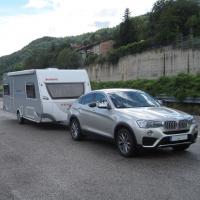
UK caravans tend to suffer more from an inherent high noseweight because they have relatively short A-frames. Their Continental counterparts usually have significantly longer A-frames. As the same chassis (AlKo or BPW) are used industry-wide, both in the UK and on the Continent, the distance from hitch to axle will be the same on both sides of the Channel. However, for given body length, a long A-frame pushes the centre of gravity of the superstructure further back, i.e. closer to the axle, resulting in lower noseweight. The only disadvantage of this is that it increases the overall length of the caravan.
It appears that keeping the overall length of the caravan as short as possible is more important to UK caravan manufacturers than those on the Continent, and that accounts for the problem.
It appears that keeping the overall length of the caravan as short as possible is more important to UK caravan manufacturers than those on the Continent, and that accounts for the problem.
I would have though that increasing the length of the A-frame (hence increasing the distance from the axle to hitch would increase nose weight due to the lever effect?UK caravans tend to suffer more from an inherent high noseweight because they have relatively short A-frames. Their Continental counterparts usually have significantly longer A-frames. As the same chassis (AlKo or BPW) are used industry-wide, both in the UK and on the Continent, the distance from hitch to axle will be the same on both sides of the Channel. However, for given body length, a long A-frame pushes the centre of gravity of the superstructure further back, i.e. closer to the axle, resulting in lower noseweight. The only disadvantage of this is that it increases the overall length of the caravan.
It appears that keeping the overall length of the caravan as short as possible is more important to UK caravan manufacturers than those on the Continent, and that accounts for the problem.
No, because you've got a longer lever supporting the same weight.UK caravans tend to suffer more from an inherent high noseweight because they have relatively short A-frames. Their Continental counterparts usually have significantly longer A-frames. As the same chassis (AlKo or BPW) are used industry-wide, both in the UK and on the Continent, the distance from hitch to axle will be the same on both sides of the Channel. However, for given body length, a long A-frame pushes the centre of gravity of the superstructure further back, i.e. closer to the axle, resulting in lower noseweight. The only disadvantage of this is that it increases the overall length of the caravan.
It appears that keeping the overall length of the caravan as short as possible is more important to UK caravan manufacturers than those on the Continent, and that accounts for the problem.
I recently carried out an informal comparison of A-frame lengths on 2008 models, using overall length less internal length to get an approximation - there were small variations but no evidence that brand or country of manufacture made any difference - either continental caravans are using shorter A-frames or UK manufacturers using longer ones.
I don't wish to dispute your findings, but they do surprise me somewhat. I recall some time ago there was more than one thread in this forum which made reference to Continentals having a partiality for A-frame mounted bicycle carriers and comments that these were uncommon in the UK because shorter A-frames made them unsuitable.

Ian,
You don't say whether you need the rear seats of the car to be up. My last three tow cars (Mondeo, SAAB, and Sorento) have seat bases that lift up. This means we can load heavy stuff in the center of the car and leave the load area free for the dogs.
Its not good practice to move haevy items to the rear of the van in order to get noseweight down as they will contribute to an increased yaw moment which can exacerbate instabilty. Use the arae around the axle for heavy items. Make sure all tanks are drained too.
You don't say whether you need the rear seats of the car to be up. My last three tow cars (Mondeo, SAAB, and Sorento) have seat bases that lift up. This means we can load heavy stuff in the center of the car and leave the load area free for the dogs.
Its not good practice to move haevy items to the rear of the van in order to get noseweight down as they will contribute to an increased yaw moment which can exacerbate instabilty. Use the arae around the axle for heavy items. Make sure all tanks are drained too.
In response to Gafferbill's comments of 18th March, I would have thought that increasing the weight in the boot would be counter-productive. Surely this will make the rear of the car sit down and hence take weight off the front wheels and make the steering light, thus creating more instability.
Mick
Mick

Mick....You are Right about removing weight from the front axle!!
If you add weight to the rear of the car, most will be transmitted to the road via the rear axle.
The much smaller amount of weight removed from the front axle will transfer to the rear axle. This should not affect the steering, as the car was not balanced until passengers, fuel and boot load were added.
It is the rear axle stability that allows transmission of the opposing forces to counteract the lateral forces the buffeted caravan applies to the tow-ball of the car.
If you add weight to the rear of the car, most will be transmitted to the road via the rear axle.
The much smaller amount of weight removed from the front axle will transfer to the rear axle. This should not affect the steering, as the car was not balanced until passengers, fuel and boot load were added.
It is the rear axle stability that allows transmission of the opposing forces to counteract the lateral forces the buffeted caravan applies to the tow-ball of the car.
GF, I'm no expert in vehicle dynamics or design (my "O" Level in physics 40 years ago didn't touch on caravan stability), but I remain unconvinced by your logic. Whether towing or solo, a car with a lot of weight in the boot becomes "light" on the steering, which is something to be particularly avoided when towing. I think where I have a problem with your theory is that it over-simplifies the scenario. A car towing a caravan is a complex arrangement with all sorts of forces being applied in all sorts of directions, and as soon as additional energy is applied to the system (in this case the bow wave of the passing vehicle) the consequences are less than predictable.Mick....You are Right about removing weight from the front axle!!
If you add weight to the rear of the car, most will be transmitted to the road via the rear axle.
The much smaller amount of weight removed from the front axle will transfer to the rear axle. This should not affect the steering, as the car was not balanced until passengers, fuel and boot load were added.
It is the rear axle stability that allows transmission of the opposing forces to counteract the lateral forces the buffeted caravan applies to the tow-ball of the car.
I can concur with your view of attempting to "anchor" the towing vehicle to the road, but I'm not sure that extra weight in the boot, which will be behind the rear axle in most cars, is the answer. I would suggest that weight on the floor in front of the rear seats would be preferable, provided that all the manufacturer's axle weights, GVW etc are complied with.
From what I have read, most snaking incidents don't start with lateral movements, it is the pitching movement of the caravan that is the problem, applying and removing downward pressure onto the towball and so removing traction from the front wheels, leading in turn to lack of control and then sideways movements. If you've ever seen it happen, it's like one of those rodeo rides with the bull twisting and pitching in every direction. That's why so many snaking incidents end up with the outfit turning over.
Happy safe towing, one and all!
Mick
http://people.bath.ac.uk/en8cjk/Caravan.pdf
Acknowledgement to Chris Killer
Department of Mechanical Engineering
University of Bath
Heavy stuff Mick..... see section 11.1
Note " Load heaviest items in the car if possible"
Acknowledgement to Chris Killer
Department of Mechanical Engineering
University of Bath
Heavy stuff Mick..... see section 11.1
Note " Load heaviest items in the car if possible"
Thanks for the link, interesting stuff. I knew that the people at Bath had done this work, but I had never seen the results in that amount of detail. I'll think about this suggestion next time I'm loading up, although on reflection I already carry awning with poles, toolkit, steel awning pegs, crate of bottles, jack, footpump etc in the car, so I guess I'm doing it already. Only difference is that, with only the two of us on-board, I drop the seats and push the heavy stuff forward rather than it being behind the rear axle.
The following is copied.
11.1 Practical advice for caravan owners & designers
Nothing fundamentally new was discovered in this study, but theoretical factors
suggested in the past have been substantiated by road-tested evidence. The
theoretical advice that is now known to be significant in increasing stability includes
the following points.
For owners:
Make sure car is suitable for the size of caravan
Load heaviest items in the car if possible
Locate other heavy items in the centre of the caravan, just forward of its axle
Make sure tow ball load is adequately high
Avoid sharp steer inputs at high speed
Never exceed 60mph
I would just like to comment, the car chosen could not tow the heavy van above 55MPH, and had worn rear suspension bushes.
Hardly an ideal towcar, i would have thought.
Along with a max nose weight limit of 75kg. I just can't understand given these restrictions, why they would use such a tow car?
11.1 Practical advice for caravan owners & designers
Nothing fundamentally new was discovered in this study, but theoretical factors
suggested in the past have been substantiated by road-tested evidence. The
theoretical advice that is now known to be significant in increasing stability includes
the following points.
For owners:
Make sure car is suitable for the size of caravan
Load heaviest items in the car if possible
Locate other heavy items in the centre of the caravan, just forward of its axle
Make sure tow ball load is adequately high
Avoid sharp steer inputs at high speed
Never exceed 60mph
I would just like to comment, the car chosen could not tow the heavy van above 55MPH, and had worn rear suspension bushes.
Hardly an ideal towcar, i would have thought.
Along with a max nose weight limit of 75kg. I just can't understand given these restrictions, why they would use such a tow car?
If the car had been ideal, the findings would not have been conclusive because it would not have revealed anything about the causes of weaknesses in towing performance. Therefore, for the purpose of testing, a less than ideal outfit is exactly what you need.
For the same reason, I would suggest that caravan clubs and magazines should always carry out their tests right at the respective manufacturers' limits rather than under typical conditions. That would make any shortcomings more obvious.
For the same reason, I would suggest that caravan clubs and magazines should always carry out their tests right at the respective manufacturers' limits rather than under typical conditions. That would make any shortcomings more obvious.
Lutz
I question the findings as follows.
1/ "make sure car is suitable for the size of van"
Just what is "suitable"?
2/ "Make sure tow ball load is adequately high", so does that mean anything under 75kg? (the max nose weight of the test car).
What i haven't copied was the findings about the 2004 ALKO, The findings were incomplete because the test car could not reach speeds over 55mph, so a conclusion could not be made?
Also snakes were induced by a sharp steering inputs, which is ok, but both myself and another with a post at present on this forum, both had our snake after being passed by a coach!, in my case i was driving in a straight line with a indicated speed of 65mph, so no sharp steering input.
I question the findings as follows.
1/ "make sure car is suitable for the size of van"
Just what is "suitable"?
2/ "Make sure tow ball load is adequately high", so does that mean anything under 75kg? (the max nose weight of the test car).
What i haven't copied was the findings about the 2004 ALKO, The findings were incomplete because the test car could not reach speeds over 55mph, so a conclusion could not be made?
Also snakes were induced by a sharp steering inputs, which is ok, but both myself and another with a post at present on this forum, both had our snake after being passed by a coach!, in my case i was driving in a straight line with a indicated speed of 65mph, so no sharp steering input.
RAY.......I repeat
Bow waves exert pressure on the relatively high sides of your caravan as the overtaking vehicles passes.
This is a positive pressure at the head or the wave, followed by a negative pressure at the tail, as it passes.
This translates to a push / pull lateral movement at the hitch point causing your tow car to slightly rear steer.
This can develop into full-blown snaking .. the main reason we fit stabilisers.
It is the rear axle stability that allows transmission of the opposing forces to counteract the lateral forces the buffeted caravan applies to the tow-ball of the car.
In your snaking incident ' the sharp steering input' was applied to the rear axle of your car by the caravan .... the so-called 'Tail wagging the dog'.
Your relatively high speed and maybe insufficient load on the rear axle of the towing vehicle aggravated your incident.
Bow waves exert pressure on the relatively high sides of your caravan as the overtaking vehicles passes.
This is a positive pressure at the head or the wave, followed by a negative pressure at the tail, as it passes.
This translates to a push / pull lateral movement at the hitch point causing your tow car to slightly rear steer.
This can develop into full-blown snaking .. the main reason we fit stabilisers.
It is the rear axle stability that allows transmission of the opposing forces to counteract the lateral forces the buffeted caravan applies to the tow-ball of the car.
In your snaking incident ' the sharp steering input' was applied to the rear axle of your car by the caravan .... the so-called 'Tail wagging the dog'.
Your relatively high speed and maybe insufficient load on the rear axle of the towing vehicle aggravated your incident.
I must admit that "suitable" is a rather nebulous statement that is difficult to define. At any rate it must mean that the manufacturer's specified towload limit for the car is adequate for the weight of the caravan. Anything beyond that is really up to personal preference and ability. Some cars handle more nervously than others when towing and require above average due care to suit the driving conditions. However, such 'twitchy' behaviour can have many causes. It is therefore impossible to give a clear cut answer and one must rely on recommendations, although everyone has different ideas about what is still acceptable and what is not.
"Make sure tow ball load is adequately high" is something one cannot influence because it is a basic design issue. The car and towbar manufacturers are fully aware that the towball must be between 350 and 420mm above the ground when the car is fully laden. Fully laden means including the maximum specified noseweight. If the towball height is outside those limits there is something wrong with the car.
There are several ways of inducing a snake. One is by steering input. The other is what you experienced (sidewind buffetting). Howevr, for the sake of the test, how the snake was induced was irrelevant. All the researchers wanted to investigate was how the outfit reacted once a snake had set in, whether the oufit is capable of restoring stability on its own - which is usually the case below 55mph - or whether the condition becomes so unstable that action is required on the part of the driver (or by electronic stabilisers that are becoming more common both on cars and caravans).
"Make sure tow ball load is adequately high" is something one cannot influence because it is a basic design issue. The car and towbar manufacturers are fully aware that the towball must be between 350 and 420mm above the ground when the car is fully laden. Fully laden means including the maximum specified noseweight. If the towball height is outside those limits there is something wrong with the car.
There are several ways of inducing a snake. One is by steering input. The other is what you experienced (sidewind buffetting). Howevr, for the sake of the test, how the snake was induced was irrelevant. All the researchers wanted to investigate was how the outfit reacted once a snake had set in, whether the oufit is capable of restoring stability on its own - which is usually the case below 55mph - or whether the condition becomes so unstable that action is required on the part of the driver (or by electronic stabilisers that are becoming more common both on cars and caravans).
You loading plan sounds good..........Thanks for the link, interesting stuff. I knew that the people at Bath had done this work, but I had never seen the results in that amount of detail. I'll think about this suggestion next time I'm loading up, although on reflection I already carry awning with poles, toolkit, steel awning pegs, crate of bottles, jack, footpump etc in the car, so I guess I'm doing it already. Only difference is that, with only the two of us on-board, I drop the seats and push the heavy stuff forward rather than it being behind the rear axle.
Thats what it is all about Mick.....knowing how to stay safe and enjoying Caravaning.
http://www.towingstabilitystudies.co.uk/index.htm
This site is pertinent to the topic... and the caravan loading game is a bit of fun!!
This site is pertinent to the topic... and the caravan loading game is a bit of fun!!
Me again......This video shows the science of the 'correct loading of a caravan' with a cute demonstration model
www.youtube.com/watch?v=PFzrWHTG5e8
www.youtube.com/watch?v=PFzrWHTG5e8
Or for something really dramatic if you want to see what happens when not attempt is made to get the outfit under control:
http://www.youtube.com/watch?v=s4MQEYe4_0Y&NR=1
http://www.youtube.com/watch?v=s4MQEYe4_0Y&NR=1
TRENDING THREADS
-
-
-
-

-

-
-
Venus Lunar 550/4 Truma Water Pump , kitchen and bathroom sink ....
- Started by Thomas Dixon
- Replies: 7

