
-
We’re currently investigating an issue related to the forum theme and styling that is impacting page layout and visual formatting. The problem has been identified, and we are actively working on a resolution. There is no impact to user data or functionality, this is strictly a front-end display issue. We’ll post an update once the fix has been deployed. Thanks for your patience while we get this sorted.
You are using an out of date browser. It may not display this or other websites correctly.
You should upgrade or use an alternative browser.
You should upgrade or use an alternative browser.
Over loaded axel!
- Thread starter Jcloughie
- Start date

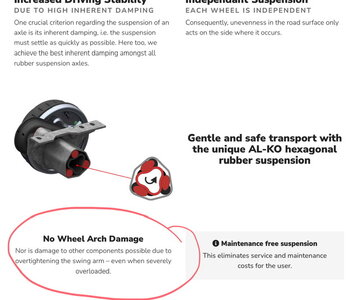
Am I correct in the belief that the arm on alko units are at 22.5 Deg to the horizontal at rest? Cheers Gary

The no wheel arch damage assumes that the rubber components act as designed and maintain conformity. My axle relaxed badly on the offside and reduced loaded clearance to around 12 mm. The rubber had partly “ extruded” from its tube so was clearly not available to resist movement. Given the state of roads I wasn’t prepared to continue to use the caravan and purchased a complete axle assembly.We read on here from from time to time o out caravan suspension that collapses and damages the wheel arch and owners being told it is their fault for overloading.
I have just found the info about Alko caravan axles.
Perhaps I am missing something .
LINK
And the relevant part being.
View attachment 6614
John
I bet that was a bob or two
Around £1300 fitted by Swift dealerI bet that was a bob or two
Ouch! at least it right now 👌
I sold it in 2021 so the new owner befitted. I also put dampers on it whilst they aren't as effective as car dampers, but at the price anything that would protect it a bit more was worth it. A recent thread described axle failure on a new Swift caravan with an MTPLM of 1300kg, but an axle rated at 1500kg, and initial discussions with the Dealer led straight to "you must have overloaded it"Ouch! at least it right now 👌
I'm aware of one occurence, reported on a caravan forum, where the owner identified a faulty suspension because the tyre had worn a hole in the top of the wheel arch - so it certainly wasn't always the case.The link suggests that there is something in the design which limits suspension movement, but to prevent wheel arch damage that must be effective before the tyre can contact the wheel arch. I have the impression that in the past that was not always the case.
I read one where an overloaded fridge was blamed.....that wasn't cool

When university of bath tested caravan suspension they concluded that the Alko dampers did not give much benefit to the Alko suspension. As I mentioned in an above post I fitted them to my new axle on the basis that at less than £100 “every little helps”. But to be honest I couldn’t feel any difference compared to the old degraded axle with no dampers, and the new axle with dampers.I wonder if fitting shock absorbers would prevent the issue?
Our our 2011 Lunar TI it made a massive difference to towing as no more open drawers and things shaking about. No idea if it helped the suspension.When university of bath tested caravan suspension they concluded that the Alko dampers did not give much benefit to the Alko suspension. As I mentioned in an above post I fitted them to my new axle on the basis that at less than £100 “every little helps”. But to be honest I couldn’t feel any difference compared to the old degraded axle with no dampers, and the new axle with dampers.
I'm aware of one occurence, reported on a caravan forum, where the owner identified a faulty suspension because the tyre had worn a hole in the top of the wheel arch - so it certainly wasn't always the case.
In that case the caravan manufacturer probably didn't check with AlKo first, how much suspension travel was available before reaching the bump stop in the axle.
I wonder if fitting shock absorbers would prevent the issue?
Possibly, but to rely on shock absorbers as a bump stop is poor practice.
When university of bath tested caravan suspension they concluded that the Alko dampers did not give much benefit to the Alko suspension. As I mentioned in an above post I fitted them to my new axle on the basis that at less than £100 “every little helps”. But to be honest I couldn’t feel any difference compared to the old degraded axle with no dampers, and the new axle with dampers.
In that case why is the weight ratio limit 30% in Germany when no shock absorbers are fitted? They surely didn't pull that figure out of a sack.
Best you direct that question to the University of Bath who worked icw Bailey. Prof probably has the reference available,. But it has been mentioned a number of time before on the Forum surprised you haven't picked it up before. Perhaps the 30% came from the same source as the 85%....anon! (TIC)In that case the caravan manufacturer probably didn't check with AlKo first, how much suspension travel was available before reaching the bump stop in the axle.
Possibly, but to rely on shock absorbers as a bump stop is poor practice.
In that case why is the weight ratio limit 30% in Germany when no shock absorbers are fitted? They surely didn't pull that figure out of a sack.
Is that the same institution that came up with the 85% theory sometime in the early 20th century that some take as being legislation?Best you direct that question to the University of Bath who worked icw Bailey. Prof probably has the reference available,. But it has been mentioned a number of time before on the Forum surprised you haven't picked it up before. Perhaps the 30% came from the same source as the 85%....anon! (TIC)
As the 30% figure is from a German source and the 85% from the UK it’s unlikely that the origins are the same. Besides, the 30% is a legal limit whereas 85% only a recommendation. One would assume that tests were carried out before the 30% limit was set because further percentage differentiations are made depending on technical spec.Is that the same institution that came up with the 85% theory sometime in the early 20th century that some take as being legislation?

AndBest you direct that question to the University of Bath who worked icw Bailey. Prof probably has the reference available,. But it has been mentioned a number of time before on the Forum surprised you haven't picked it up before. Perhaps the 30% came from the same source as the 85%....anon! (TIC)
Is that the same institution that came up with the 85% theory sometime in the early 20th century that some take as being legislation?
From the research I have done, no university has ever been involved with the development of the UK caravan industries tow ratio advice. In fact I have been unable to discover any formal or evidence based process used to inform the creation of the Industry advice.
Makes you winder where the CC got the 85% guideline if it was not from a university?And
From the research I have done, no university has ever been involved with the development of the UK caravan industries tow ratio advice. In fact I have been unable to discover any formal or evidence based process used to inform the creation of the Industry advice.
Despite numerous threads seeking the source of the 85% recommendation no one has ever been able to pinpoint where and when it came from. Lost in the depths of time.Makes you winder where the CC got the 85% guideline if it was not from a university?

I suspect (but have zero evidence) that it came from "self-appointed expert opinions". All done with the best of intentions no doubt but as you say, the origins now confined to the mysteries of the world.........Despite numerous threads seeking the source of the 85% recommendation no one has ever been able to pinpoint where and when it came from. Lost in the depths of time.
You might be interested in this University of Bath 2013 MPhil project thesis concluding that the Alko dampers have significantly less effectiveness than would normally be provided by dampers for example. Laboratory testing combined with theory was followed by a series of tests at the Millbrook proving ground using a Bailey Valencia caravan. Overall the Alko dampers were considered nit to be particularly effective. The caravan failed to complete the tests as it chassis fractured.In that case the caravan manufacturer probably didn't check with AlKo first, how much suspension travel was available before reaching the bump stop in the axle.
Possibly, but to rely on shock absorbers as a bump stop is poor practice.
In that case why is the weight ratio limit 30% in Germany when no shock absorbers are fitted? They surely didn't pull that figure out of a sack.
There’s also an earlier 1994 PhD study that might be of interest.
PS even the ubiquitous Alko spare wheel carrier is criticised.
Last edited:

Did I quote the wrong study?You might be interested in this University of Bath 2013 MPhil project thesis concluding that the Alko dampers have significantly less effectiveness than would normally be provided by dampers in cars for example. Laboratory testing combined with theory was followed by a series of tests at the Millbrook proving ground using a Bailey Valencia caravan. Overall the Alko dampers were considered nit to be particularly effective. The caravan failed to complete the tests as it chassis fractured.
There’s also an earlier 1994 PhD study that might be of interest.
I couldn’t possibly comment 😱Did I quote the wrong study?
You might be interested in this University of Bath 2013 MPhil project thesis concluding that the Alko dampers have significantly less effectiveness than would normally be provided by dampers for example. Laboratory testing combined with theory was followed by a series of tests at the Millbrook proving ground using a Bailey Valencia caravan. Overall the Alko dampers were considered nit to be particularly effective. The caravan failed to complete the tests as it chassis fractured.
There’s also an earlier 1994 PhD study that might be of interest.
PS even the ubiquitous Alko spare wheel carrier is criticised.
I've just had a quick look at those two findings and my initial response without going into detail of reading over 200 pages would be that the first one concentrated on the effect that dampers may or may not have on overall chassis performance and durability, and the second more on lateral stiffness. That dampers won't affect lateral stiffness is very much to be expected. However, neither of the two reports seem to go into much detail on the effect of dampers on vehicle handling, in particular in something like the "Elk test" and that's where I would have expected results that confirm benefits for fitting dampers, ultimately leading to the significant legal weight ratio restriction in Germany if they are not fitted.
TRENDING THREADS
-

-
-
-
-
 Mandatory eye tests for drivers over 70 being proposed by HMG. Good or bad?
- Started by Dustydog
- Replies: 227
-
Caravan Battery we think is dead even though we have solar
- Started by Saxo Appeal
- Replies: 172

